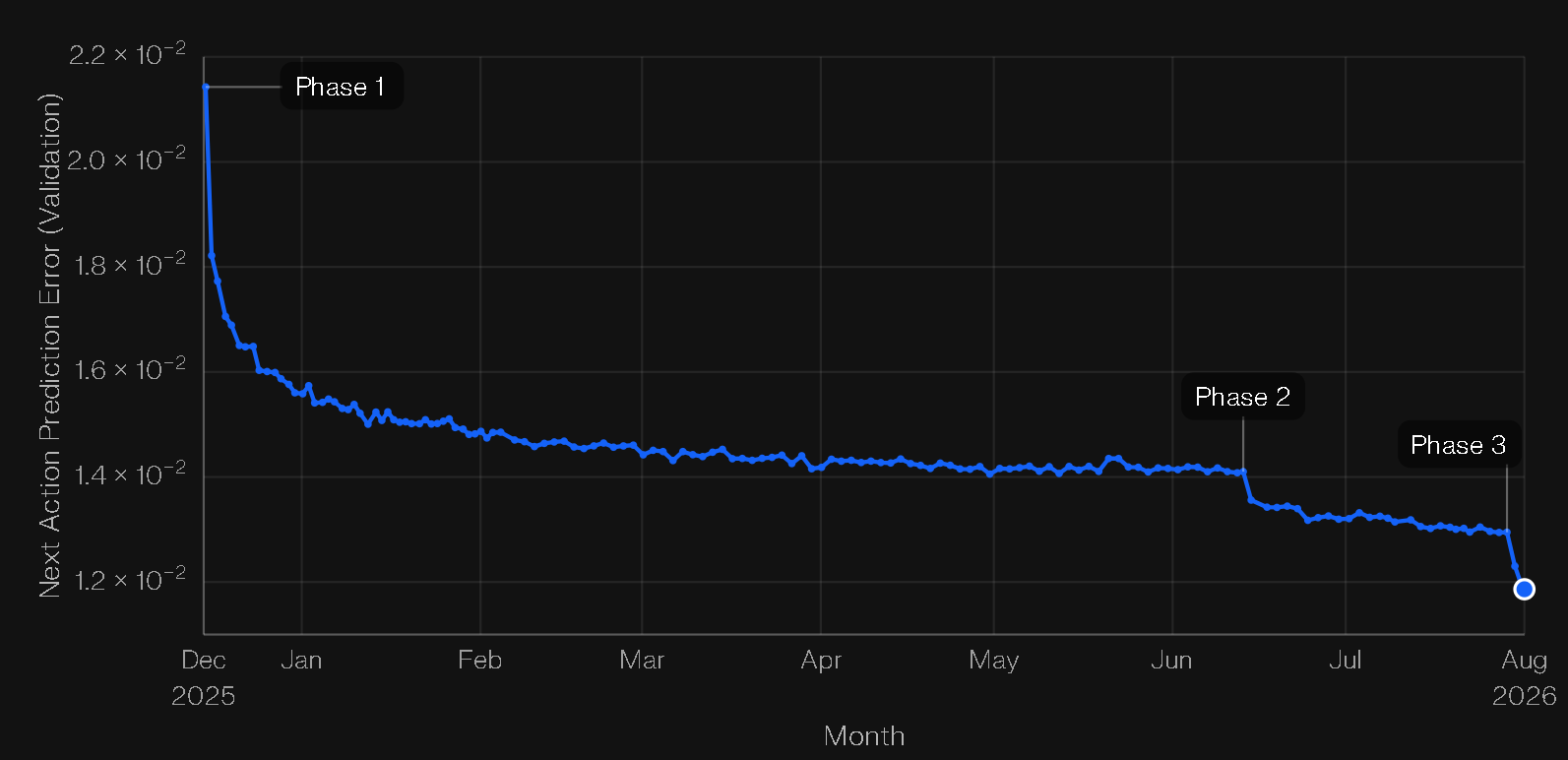
Generalist AI is the first company to demonstrate clear scaling laws in robotics, with its GEN-1.5 model continuing to show smooth performance improvements after eight months of pretraining.
Last week, Radical portfolio company Generalist AI released its latest robot foundation model, GEN-1.5. Researchers from OpenAI, Google DeepMind, Waymo, Nvidia, Prometheus and other top labs hailed GEN-1.5 as the “GPT-3 moment for robotics.”
What exactly does it mean for GEN-1.5 to have achieved a GPT-3 moment for robotics?
The 2020 OpenAI paper that introduced GPT-3 to the world was titled “Large Language Models Are Few-Shot Learners”. The significance of this title was that GPT-3, once initially pretrained, could learn to complete novel tasks competently based on just a few examples (via either in-context learning or efficient fine-tuning), rather than needing to be shown thousands or tens of thousands of examples. This made GPT-3 a “general intelligence” in a way that no language model that had come before it had been.
GEN-1.5 represents a parallel milestone for robotics. It stands as the first time that a robotic AI model has the ability to learn to complete novel tasks not contained within its training data based on only brief demonstrations: a few seconds of sensorimotor examples, or a single demonstration recorded in simulation (even though the model was not trained on any simulation data), or a person demonstrating a task live with their own hands in front of the robot’s cameras. Generalist coins a memorable term for this: physical prompting, analogous to prompting an LLM.
Generalist’s GEN-1.5 paper title is thus a fitting homage: “Embodied Foundation Models Are One-Shot Learners”.
GEN-1.5 (like GPT-3) possesses other startling and unexpected emergent capabilities, like the ability to use tools it has never seen before. One example: after being taught a clean-up task using a brush, the model is able to complete the same task using a banana and then a dust-pan, using these tools in different ways than it had been using the brush in order to achieve the same outcome, even though it had never seen these tools before. Such “improvisational intelligence” is possible only because the model has internalized and absorbed rich, generalized sensorimotor knowledge about the physical world.
Over the past half-decade, large language models have taken the world by storm as their ability to automate digital tasks has grown increasingly generalized and sophisticated. Robot foundation models are poised to follow a similar trajectory, but in this case for the physical world. Just like LLMs over the past few years, these models are beginning to improve at breathtaking speed. Buckle up!
Learn more by reading Generalist’s technical blog on GEN-1.5 on their website.
AI News This Week
- This A.I. Start-Up Aims to Reverse the Backlash Against Data Centers (NYT) — Radical Ventures portfolio company Emerald AI raised $150 million at a $1.05 billion valuation to help data centers ease their strain on electricity grids. DCVC and Energize Capital led the round, with Nvidia among the strategic investors joining. Emerald’s software lets data centers raise or lower power draw in response to utility signals, freeing capacity when demand peaks. CEO Varun Sivaram, a renewable energy veteran and former White House energy security official, told the New York Times he wants to turn data centers from grid burdens into grid assets. The company has run pilots with Nvidia and Oracle and signed contracts in California and Virginia.
- TIME100 AI 2026 List (Time) — TIME’s 2026 ranking of the 100 most influential people in AI includes leaders from three Radical Ventures portfolio companies. Joëlle Pineau, chief AI officer at Cohere, was recognized for steering the enterprise AI company toward open-source models, including its Command A+ system, and its North platform serving regulated industries and government. Anna Goldie and Azalia Mirhoseini were named innovators for Ricursive Intelligence, where their reinforcement learning systems automate semiconductor design. Finally, Fei-Fei Li, Radical Ventures Scientific Partner, was honoured for her work at World Labs on spatial intelligence and models that reason about the physical world.
- Inherent, Founded by DeepMind Alumni, says its AI ‘Teammate’ just Outperformed Anthropic and OpenAI at Replicating Research (TechCrunch) — Radical Ventures portfolio company Inherent, a lab founded by Google DeepMind alumni, released an AI agent called Faraday that reproduces the findings of published scientific papers without being given the answers in advance. The company says Faraday runs on a 27-billion-parameter model yet outperformed much larger frontier systems from Anthropic and OpenAI on the replication task. Chief scientist Edward Hughes maintains that the method matters more than the result, with his team using reinforcement learning to give Faraday a sense of research taste rather than fixed rules. Inherent’s longer goal is AI that generates new scientific knowledge.
- This AI Startup’s New Model Could Unlock Cost-Effective Computer Use (Upstarts) — Radical Ventures portfolio company Yutori released n2, a model built for computer use that operates software much as a person would. Within a single task, it moves between a graphical interface and faster command-line or API routes, choosing whichever fits the step. Trained on 27 billion parameters, n2 delivers performance close to far larger models at a fraction of the cost, which co-CEO Devi Parikh says is what makes computer-use products viable to ship at scale.
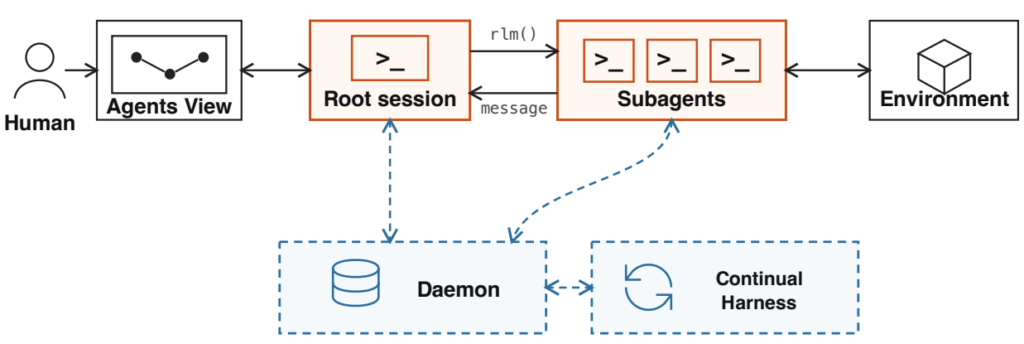
- Research: Prime Agent – A Self-Improving RLM Harness (Prime Intellect) — Long-running AI agents are often limited by their surrounding software rather than the model itself. Radical Ventures portfolio company Prime Intellect released Prime Agent, an open-source harness that gives a fixed model persistent memory, a programmable Python workspace, and recursive sub-agents it can coordinate. Skills, histories, and learned procedures carry across sessions, so earlier work informs later runs. On the ARC-AGI-3 reasoning benchmark, the paper reports best-attempt scores of 95.5% when the harness is paired with a frontier model, near the 95.4% human baseline and above the roughly 30% recorded on a standard setup. The authors argue that training models and harnesses together will become a primary route to longer-horizon capability.