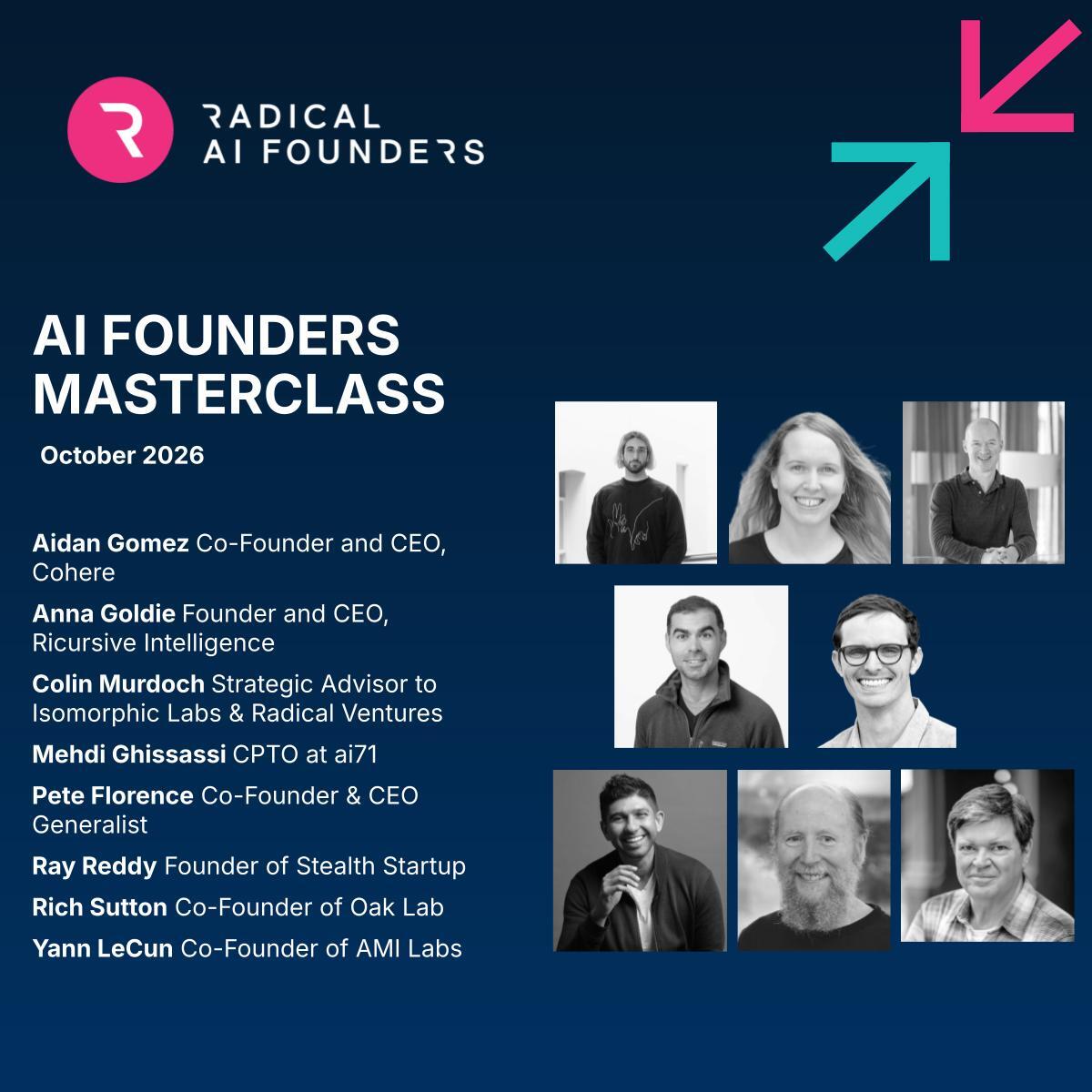
This October, Radical Ventures hosted its sixth annual AI Founders Masterclass, a virtual program for AI researchers and technical founders who want to build companies. Hundreds of participants from universities, startups and research labs joined live conversations with Yann LeCun, Aidan Gomez, Rich Sutton, Anna Goldie and other leading figures in AI. Over four weeks, these AI icons and entrepreneurs shared how they turned research into products, led when the path ahead was unclear, and spotted ideas before the rest of the field caught on.
We’ll be sharing excerpts on our podcast in the coming weeks. Here are some of the highlights.
The Next Frontier
Yann LeCun, Co-Founder and Executive Chairman of AMI – Advanced Machine Intelligence, shared why AMI is betting on world models. In his view, a true world model predicts the consequences of actions so a system can plan. It’s why a 17-year-old learns to drive in about 20 hours, while self-driving still isn’t solved after billions of hours of data.
Rich Sutton, reinforcement learning pioneer and Co-Founder of Oak Lab, closed the program with a lesson on seeing the obvious. Reinforcement learning began as an idea that seemed obvious to him but that the field wasn’t pursuing. Today, he argues, the obvious gap is that AI doesn’t keep learning from experience, the focus of Oak Lab. For startups, his Bitter Lesson means general principles scale, while solving every specific case becomes “one damn thing after another.”
Choosing the Right Problem
Anna Goldie, Co-Founder and CEO of Ricursive Intelligence, kicked off the Masterclass with Radical Partner Rob Toews and presented a case for reaching for the high-hanging fruit. Hard, highly consequential problems face less competition and attract the strongest people. That’s why Ricursive started with the hardest part of chip design, the area where Anna and co-founder Azalia Mirhoseini created AlphaChip at Google.
Colin Murdoch, former CBO of DeepMind and now Strategic Advisor at Isomorphic Labs and Radical Ventures, shared how Isomorphic identified its business model. Before spinning out, the team spoke with more than 100 pharma experts and learned that pharma spends far more on developing drugs than on software. “The money is in the molecule” became the foundation of the business, and a reminder to get deep in your customers’ world before you build.
From Research to Company
Mehdi Ghissassi, Chief Product and Technology Officer at ai71 and former Head of Product at Google DeepMind, joined Radical Partner Aaron Rosenberg to discuss turning research into products. Enterprise customers don’t ask for more intelligence. They come with a specific problem, like a credit decision or a legal workflow, and solving it means understanding how that work gets done.
Pete Florence, Co-Founder and CEO of Generalist, shared why he left Google DeepMind. Generalist’s mission was never going to be one of Google’s top priorities, and a startup let him build a team around it. Generalist bet on scale early, building a robotics dataset 27 times larger than any other at the time. This summer, its Gen 1.5 model began learning new tasks from a single example.
The People Side of Building
Aidan Gomez, Co-Founder and CEO of Cohere, told Radical Managing Partner Jordan Jacobs why Cohere hired the best people wherever they were instead of defaulting to Silicon Valley. A distributed team is harder to lead, but it opens up overlooked talent and footholds in markets worldwide. He also urged founders to choose co-founders deliberately, treating the relationship like becoming siblings.
Ray Reddy, serial entrepreneur and former VP of Product at Shopify, shared the story of Ritual, the order-ahead app he led as founder and CEO for more than a decade. Ritual grew 2 to 3x a year by winning one neighbourhood at a time, until the pandemic erased about 90% of its revenue in a week. His biggest lesson is that a leader’s job is to provide direction, not certainty.
Looking Ahead
A few ideas kept coming up. Pick problems that matter, get close to the people you’re building for, and be honest about what you don’t know yet. Thank you to our speakers and to everyone who joined each week.
Masterclass Edition episodes with Anna Goldie and Mehdi Ghissassi are now live on Radical Talks. Sign up to hear about next year’s speaker lineup here.
AI News This Week
- Radical called the AI Boom Early. Now it’s Doubling Down (PEI) — The Radical Breakouts Fund raised more than $1 billion in a 30-day first close toward a $3 billion target, making it the largest venture capital fund in Canadian history. Breakouts will back AI scale-ups on a path to becoming the next trillion-dollar businesses. Its first three investments are in portfolio companies Etched, Crusoe, and Discovery Loop, the latter led by former Google chief scientist Jeff Dean. The fund’s thesis holds that AI will be embedded in all software within a decade and will speed up discovery in drugs, materials, and robotics.
- AI’s Newest Billionaires Want No Part of Superintelligence Race (Bloomberg) — While the industry spends heavily on ever-larger models, Radical Ventures portfolio company Cohere is building a business on models sized to what enterprises need. The company focuses on efficient models that customers can run on their own servers, which is a strong selling point for banks, healthcare companies, and governments that handle sensitive data. Its customer base grew 20-fold over the past year to about 300 companies. Cohere’s latest funding round valued the company at $25.5 billion, making co-founders Aidan Gomez, Nick Frosst, and Ivan Zhang Canada’s first AI billionaires.
- New Research Tests Whether AI Models Know Their Own Thoughts (Quanta) — Researchers are turning questions about machine introspection into testable experiments by injecting specific concepts into a language model’s neural activity and asking whether it notices. The most capable version of Claude flagged the injection and named the concept in 20% of trials with no false positives. The models’ ability to sense that something had changed held up under testing, which surprised researchers because no model is trained to monitor its own neural activity.
- How “Reverse Game Theory” Could Keep AI Agents in Check (MIT) — AI safety researchers are borrowing from economics to keep agents in line. Mechanism design, or “reverse game theory,” builds rules that make desired behaviour the rational choice, much as second-price auctions encourage honest bids. MIT’s Stephen Morris proposes rewarding models for predicting a second model’s answers, making deliberate underperformance on safety tests a losing strategy. Princeton’s Elad Hazan has models alternate as solvers and auditors, penalizing both cheaters and the auditors who miss them.
- Research: Can Frontier Models Solve Real-Time Interactive Problems (UT Austin/Ohio State/UIUC/NVIDIA/Northwestern/Steadyworks) — AI agents bidding in an auction or booking a seat before it sells out need to act quickly and correctly. Realtime-Bench measures speed and accuracy across 50 web and game tasks, where the environment keeps changing while a model reasons. With real-world response times, the best model completed 44% of tasks. When the environment paused while models reasoned, leading models completed 70 to 80%. Extra reasoning helped when the clock was frozen but had mixed results under time pressure, as some models kept deliberating until the window to act had closed. The authors call for models that scale their reasoning to the time available.
Subscribe to Radical Reads for our weekly insights from the frontier of AI
Radical Reads is edited by Ebin Tomy (Analyst, Radical Ventures)