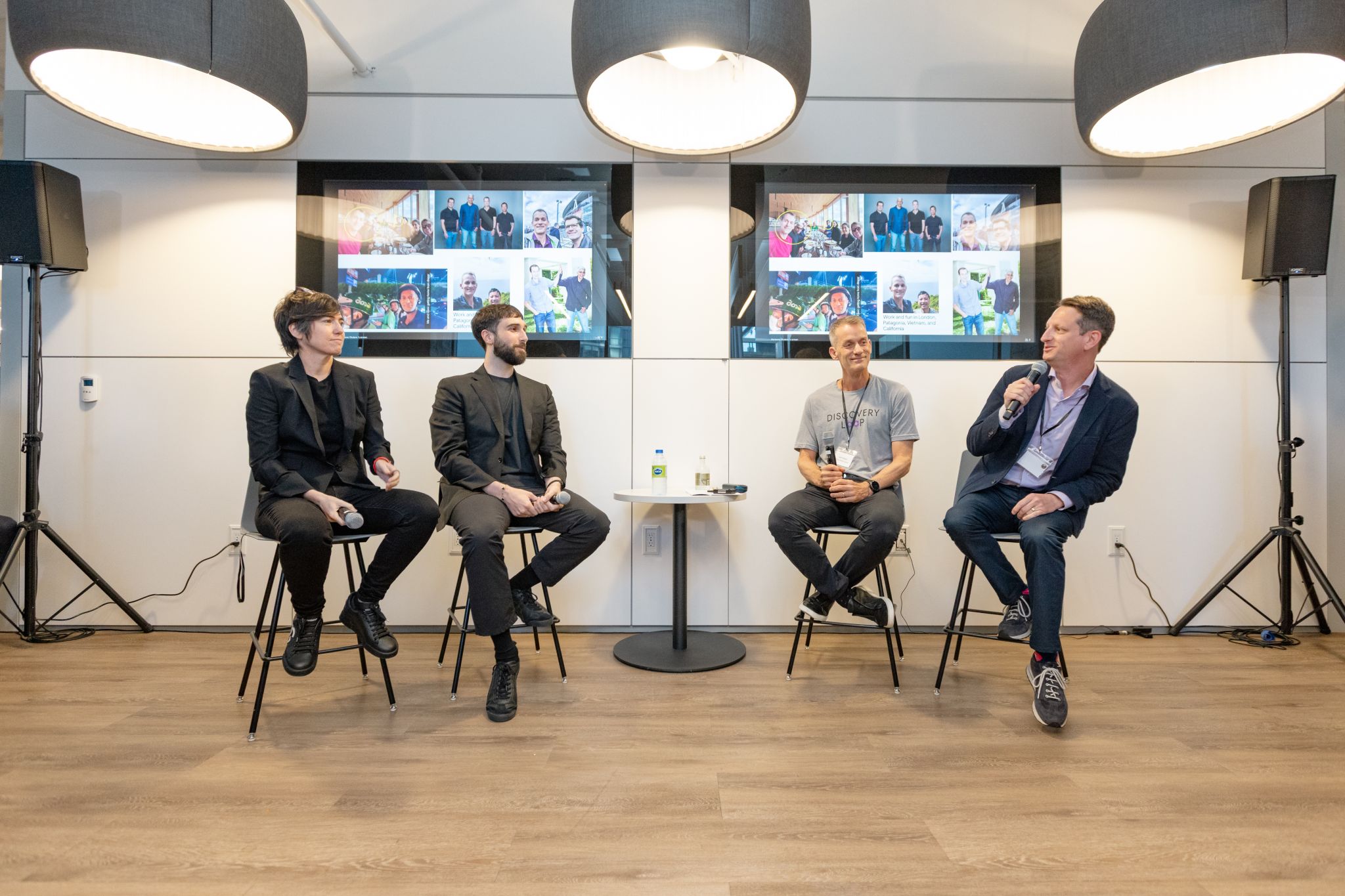
L-R: Raquel Urtasun, Founder and CEO of Waabi; Aidan Gomez, Co-founder and CEO of Cohere; Jeff Dean, Co-founder and CEO of Discovery Loop; and Jordan Jacobs, Co-founder and Managing Partner of Radical Ventures.
Last week we announced the first close of the multi-billion-dollar Radical Breakouts Fund, with well over US$1 billion committed to the new strategy in the first closing.
We have been building toward this since our first institutional fund in 2019. Radical helped launch Cohere, Waabi and World Labs. We led or joined venture and early growth rounds in Discovery Loop, Etched, Crusoe, Generalist, Prime Intellect, Decart, Latent Labs, Veeda, Xanadu, Muon Space and Aspect Biosystems. What we have not always been able to do is back companies through later rounds of hyper-growth. Radical Breakouts Fund changes that.
The reality is that technology companies are staying private far longer than they once did. They are raising successive large private rounds, and many will reach the public markets already worth US$100 billion or more. The majority of value creation in this generation of companies now happens before the IPO, and capturing that value requires larger-scale private capital.
We compete to partner with the best AI founders globally, and increasingly the founders who matter most come to us first. We have been AI specialists since before that was a category, and AI founders want like-minded, mission-driven investors who have also been AI founders and understand what they are actually building.
The first close of the Breakouts Fund was anchored by PSP Investments, CPP Investments, HOOPP, TD Bank Group, BMO Financial Group, CI Global Asset Management and OPTrust, alongside other leading global investors. Several have backed Radical since the beginning. We are very grateful for their conviction and partnership.
We announced the fund at the inaugural Canada Investment Summit in Toronto. Canadian Prime Minister Mark Carney highlighted the new fund, noting it is already the largest venture fund ever raised in Canada. This is something we are proud of, but the mandate for the Breakouts Fund is global, and so is the opportunity. Already, Breakouts is investing in 3 companies: Discovery Loop, Etched and Crusoe.
The next generation of trillion-dollar companies is being built right now. We intend to invest and partner with the best of them, from day zero through IPO.
Learn more about the Radical’s Breakouts Fund from our news release.
AI News This Week
- Artificial Intelligence Now Beats Some of the Best Human Forecasters (Economist) — Radical Ventures portfolio company Mantic outscored all 676 human entrants in this summer’s Metaculus Cup, the most rigorous public test of forecasting ability. Metaculus scores participants on probabilistic estimates across roughly 60 world events and rewards accuracy held over four months, making its leaderboard one of the few credible records of who predicts well. AI systems took first, second, and fifth place, leaving humans third and fourth. The Forecasting Research Institute found in July that AI has reached parity with professional superforecasters. Mantic recently announced their $25 million seed round, led by Radical Ventures, with participation from Balderton, Thinking Machines, and DRW, among others.
- The Startup That Built OpenAI’s Biggest Data Center Is Now Making Tiny Ones (WSJ) — Radical Ventures portfolio company Crusoe raised $3.9 billion at a $30.9 billion valuation, co-led by Atreides Management, Mubadala Capital, and Valor Equity Partners, with participation from Founders Fund, NVIDIA, TPG and Radical Ventures, among others. The company reports more than $140 billion in total contracted value and over 6GW of contracted capacity. Crusoe spent two years building OpenAI’s Stargate Abilene campus, one of the world’s largest AI supercomputers and the site where OpenAI trained its most advanced systems. The company is now manufacturing Crusoe Spark, modular data center units that can be trucked to sites with available power and assembled in weeks rather than years.
- Tech Giants Launch Flexible-Power Coalition for Data Centers (Axios) — Public opposition has become a real constraint on AI buildout, with 84% of Americans being concerned about data centers’ impact on local electricity prices, and bipartisan majorities backing rules that would make developers pay for grid upgrades. A coalition of 20 companies and organizations, including Google, Nvidia, and Anthropic, launched this week to push regulators to treat data centers as flexible power users rather than constant ones, trading faster grid connections for the ability to cut demand when supplies are tight. Radical Ventures portfolio company Emerald AI is a founding member of this coalition and builds software that lets data centers modulate power draw by shifting and pausing AI workloads. CEO Varun Sivaram argues that facilities should earn faster connections only where their flexibility can be verified and enforced.
- ‘I Had a Superpower’: Investors Pile into Mind-Reading Brain Implants (FT) — Restoring speech and movement to people who have lost them is shifting from science fiction into commercial product development. Companies building brain-computer interfaces, which convert neural activity into digital commands, raised more than $1 billion in 2026, exceeding the previous four years combined. The most ambitious devices are surgically implanted, some with electrodes that penetrate the brain for long-term use and others placing thin, flexible arrays on the brain’s surface without piercing it. Radical Partner Rob Toews has written extensively about the field and the range of approaches startups are taking.
- Research: Self-Evolving Execution Structures for LLM Agents — (Google/Georgia Tech/Peking) Agents that plan over long horizons pick each action from a growing log of prior steps, leaving the procedure implicit and causing them to lose the objective and repeat unproductive actions. Researchers stored that procedural knowledge as a directed graph, with each link recording when to move to the next step and what to avoid along the way. A guidance model reads the links around the agent’s current position and shapes its next action without dictating it. The graph edits itself by contrasting failed runs with successful ones. Across seven benchmarks and four frontier models, this technique placed first or joint first in 21 of 24 settings, without updating model weights.
Subscribe to Radical Reads for our weekly insights from the frontier of AI