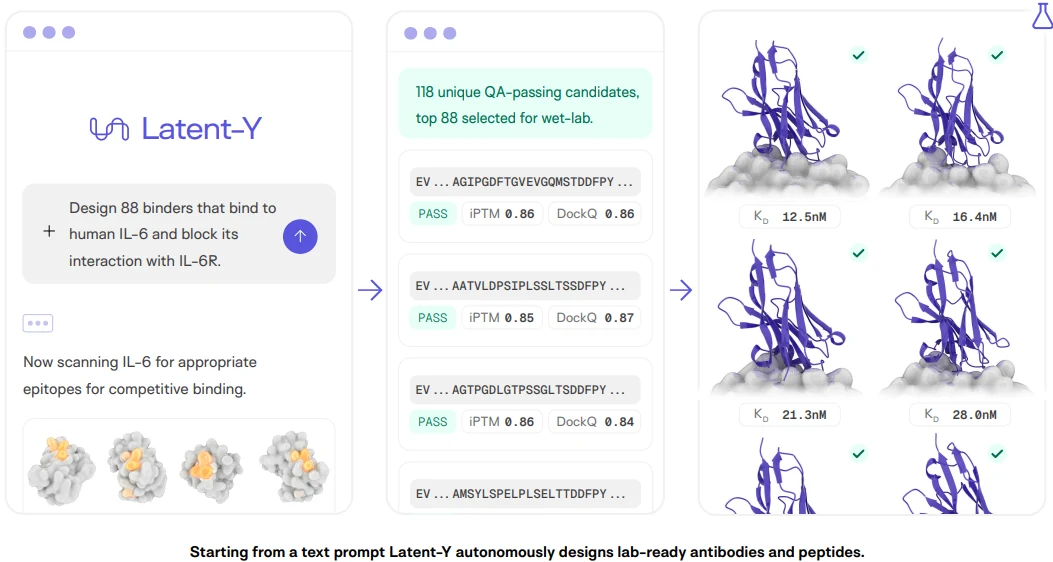
Drug discovery has always been constrained by expert time. Designing a viable binder takes weeks of specialized work, and few labs have a protein designer who can do it. Latent-Y removes that constraint, turning a plain-language goal into lab-ready candidates by working through target analysis, epitope selection, and refinement the way a specialist would.
Ahead of the launch, we gave early access to groups spanning ion channel biology, cancer immunotherapy, and infectious disease, including some with no computational design experience. The response was extraordinary.
A UC Davis lab generated nanobody inhibitors for one of the field’s hardest targets (a human ion channel) from scratch, with most candidates working on the first attempt. A group at LMU University Hospital in Munich built designed binders to generate cancer-killing immune cells, which have now moved into animal studies. And a researcher at the Broad Institute tackled a cancer-linked target with no existing treatment, work that would normally need a dedicated computational team his lab lacks.
In our published results, Latent-Y achieved a 67% target-level success rate across nine targets and completed campaigns 56 times faster than independent expert estimates. Given only a scientific paper to work from, the agent correctly identified the target site every time.
Every approved researcher receives a free daily quota of 250 designs, with more available on demand. Just as coding agents accelerate software development, Latent-Y lets one person run dozens of campaigns in parallel, each with expert-level reasoning, all from a single prompt. We built this tool to be a force multiplier for researchers, for a future where designing a drug looks less like a years-long experimental endeavour and more like a search query on the web.
Read our full technical report and blog post for more details on these results, and apply for access yourself at platform.latentlabs.com.