Robots should not go to school in the real world. While scaling physical AI will require robots to learn through active interaction — just like humans do — the physical world is not a practical training ground for trial and error. It is expensive, time-consuming, and ultimately unsafe. Instead, robots and all physical AI systems need to learn in simulated reality environments. World Models are the foundational technology that will make this shift possible, serving as the critical bridge between digital intelligence and physical execution.
This is the driving force behind Radical Ventures co-leading an investment alongside Khosla Ventures in Veeda AI, which has just emerged from stealth. Veeda is building a multimodal foundation for physical AI in which world models seamlessly simulate physical reality to unlock interactive learning for autonomous systems. By processing complex sensor data alongside real-time action inputs, Veeda’s architecture generates highly accurate physical-world states and automated reward signals. This creates a deeply reactive environment where robots can learn, reason, and adapt before ever setting foot in the real world.
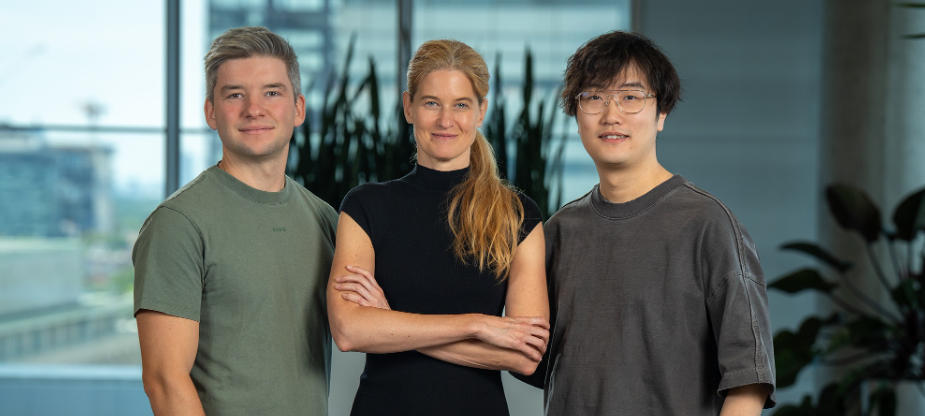
Radical Ventures is thrilled to back a founding team drawn from among the vanguard of spatial intelligence. Before co-founding Veeda, CEO Sanja Fidler was VP of AI Research at NVIDIA, where she led the Spatial Intelligence Lab and co-pioneered foundational advancements in 3D scene synthesis and generative AI. Co-founder Zan Gojcic, formerly a Director of Research at NVIDIA, provides deep expertise in neural reconstruction and building the high-fidelity simulation environments necessary for training autonomous agents. Co-founder Huan Ling, formerly a Research Manager focused on Generative AI at NVIDIA and later Chief Scientist at a generative AI startup, brings unmatched experience in developing the real-time, high-resolution visual synthesis required for these complex systems. Together, they possess the technical pedigree needed to build the core foundation for the future of robotics and automation.
Learn more about Veeda’s mission, approach and team on their website.
AI News This Week
- I Saw the Future of AI in a Robot That Can Learn on the Spot (Wired) — Radical Ventures portfolio company Generalist AI released GEN-1.5, a robot foundation model that learns new manipulation tasks from one demonstration in seconds, with no fine-tuning or gradient updates. The company describes this one-shot, in-context learning as an emergent property of large-scale pretraining, an ability it did not explicitly train for and one that echoes how GPT-3 learned language tasks from a few examples. Across ten tasks, the model averages 59% success from a single demonstration, rising to 83% after ten gradient steps on five minutes of data. GEN-1.5 also improvises, for example, using a banana or dustpan as a makeshift brush when its usual tool is intentionally removed.
- A $21 Billion ‘Kids in Chips’ Startup Is Scooping Up Nvidia Talent (WSJ) — Etched, a Radical Ventures portfolio company, has raised close to $2 billion to build semiconductors optimized for AI inference. The quantitative-trading firm Jane Street signed on as the first customer and is now leading a $700 million round that values Etched at $21 billion. The company has booked more than $1 billion in orders and started shipping. It took 44 days to get test chips from TSMC running inference workloads, against the usual six months, and its cluster-scale memory design handles some chip-to-chip communication in 700 nanoseconds versus 4,000 for an Nvidia Blackwell processor.
- Muon Space Raises $250 Million With Google, Salesforce Backing (Bloomberg) — Radical Ventures portfolio company Muon Space closed a $250 million Series C round led by Eclipse Capital, with backing from Google, Salesforce Ventures and Radical Ventures. Founded in 2021, the satellite maker has raised more than $386 million in equity and will use the new capital to accelerate production and expand into orbital AI computing. Muon has launched 11 satellites and opened a California facility capable of producing hundreds of spacecraft a year. It holds more than $10 billion in orders from customers including NASA, NOAA, and the US Space Force, and unveiled Condor-Ultra, a spacecraft platform that could host orbital data centers.
- Could More Brain-like Chips Provide a Path to Consciousness? (Economist) — Regular computers keep processing and memory separate, so information has to shuttle between them, which burns a lot of energy. Brains do both jobs in the same place, which is part of why a human brain runs on about 20 watts while a comparable AI system would need a data center drawing millions of watts. This gap has researchers exploring more brain-like designs, including chips that store and compute in one spot and even computers built from living human neurons.
- Research: Embodied Foundation Models are One-Shot Learners (Generalist) — Going deeper on Radical Ventures portfolio company Generalist AI‘s GEN-1.5, the model is a large multimodal system that ingests 30 seconds of video memory alongside sensor, language, and body-position inputs to produce continuous action trajectories. New tasks are specified through “physical prompting,” where a 3-to-12-second sensorimotor demonstration is placed in the context window, and the model acts on it with no training. Prompts compose, so two independently recorded demonstrations chain into one longer behaviour, and they cross domains, with simulated or human-hand demonstrations transferring to the real robot despite no simulation data in pretraining.