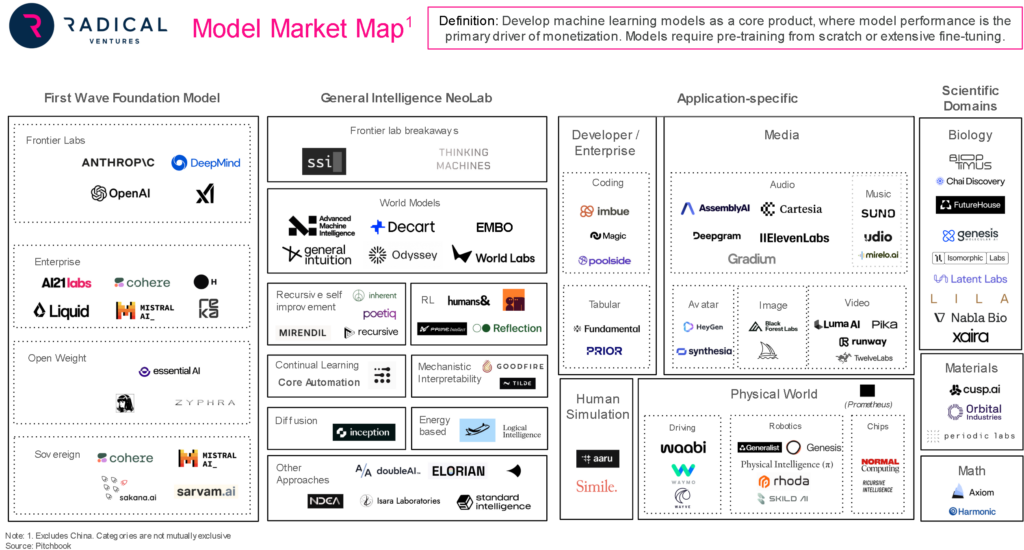
This week, partners Aaron Rosenberg and Rich Kotite published ‘The Rise of the NeoLab’, a research report tracking the wave of researcher-led frontier AI labs that have raised more than $40B in aggregate since 2024. Below is an excerpt from their article. Read the full piece here.
In June 2024, Ilya Sutskever announced the creation of a new lab with “one goal and one product: a safe superintelligence.” Within four months, Safe Superintelligence (SSI) had raised $1 billion, and less than a year later it was valued at $32 billion, still without a public roadmap. The point was not what SSI had demonstrated but rather whom they had assembled, what they were pursuing, and how much capital was willing to follow.
SSI did not appear in isolation. A cohort of researcher-led labs was coming into existence: Thinking Machines, World Labs, Reflection, and others, built from teams leaving OpenAI, Google DeepMind, Meta, and pedigreed professorships. Together, they marked the arrival of a new shape of company: the NeoLab, a startup focused on long-term technical breakthroughs, typically founded by research scientists and engineers from leading AI industrial or academic organizations.
Up until then, the post-ChatGPT frontier had looked largely settled; capital requirements seemed too large for startups to match, leading talent had concentrated inside a handful of players, and the hyperscalers had paired off with their chosen labs (Microsoft with OpenAI, Amazon with Anthropic, and so on).
Then, the floodgates opened.
Over the next three years, 40+ NeoLabs raised $40B, frequently with billion-dollar first rounds, proving that frontier-scale ambition was no longer solely the prerogative of incumbents.
Read Aaron and Rich’s full breakdown of the NeoLab cohort and market map here.
Join Radical’s 6th Annual AI Founders Masterclass and Compute Program
Applications are now open for the 2026 AI Founders Masterclass — our annual four-week virtual program for AI researchers and technical entrepreneurs, running October 7–28. This year’s speakers include luminaries Yann LeCun, Aidan Gomez, and Anna Goldie, among others. The program is designed for researchers, students, and technical founders looking to make the transition to launching a startup, with the opportunity to learn directly from those who have done it before. Participants also have an opportunity to apply to our selective Compute Cohort, which provides accepted founders with up to $250,000 in compute credits, mentorship from our team, and more. Spots are limited. Apply here: https://radical.vc/masterclass/
AI News This Week
Want to Get a Data Center Online Quickly? Give it Some Flex. (MIT Technology Review)
Because new power generation can take up to eight years to come online in some regions, data centers face long waits to connect to the grid. A growing body of research suggests that facilities that can reduce their power draw during the few peak-demand hours each year could tap existing capacity instead. A Duke University study found the US grid could accommodate 76 gigawatts of additional load from facilities willing to curtail usage roughly 22 hours a year. Radical Ventures portfolio company Emerald AI has developed a software platform called Conductor that throttles power to AI chips during demand spikes while prioritizing the most time-sensitive jobs. After tests in data centers in Phoenix, Virginia, and London, Emerald will deploy Conductor this year at a 96-megawatt facility in Manassas, Virginia, its first deployment on a live grid.
Cohere CEO on G7 Leaders’ Choice: Sovereign AI or Digital Serfdom (Fortune)
Sovereign AI was top of mind as G7 leaders and AI executives gathered this week. Anthropic’s recent removal of its Fable 5 and Mythos models under a US government order, which cut off all non-American users, sharpened the concern that countries relying on a handful of providers could lose access to critical systems beyond their control. Radical Ventures portfolio company Cohere, whose CEO Aidan Gomez attended the Summit, is positioned to address this exact issue, providing models that governments and enterprises can run inside their own secure environments with full custody of models and data. Gomez used the occasion to state that nations should diversify among providers rather than rent core capabilities from centralized sources.
The Data-Center Panic Is Overblown (The Atlantic)
This essay argues that the public backlash against the AI data center build-out overstates the downsides and addresses some common critiques. Specifically on water usage, the piece notes that many facilities use closed-loop cooling that recycles water rather than consuming it, an approach taken by Radical Ventures portfolio company Crusoe, which operates non-evaporative cooling at its sites. The author calculates that all US data centers account for less than 0.5 percent of national freshwater use, compared to nearly 2 trillion litres used for golf courses.
Did AI Write this Article? (The Economist)
AI has sharply lowered the barriers to producing creative and knowledge work, and new data shows the effect across five fields. Monthly e-book releases on Amazon tripled to around 300,000 after ChatGPT’s launch. Self-filed US civil lawsuits doubled to 41,000 between 2023 and 2025, with success rates holding steady, suggesting AI is helping more people press claims without a lawyer. Apple App Store releases passed 100,000 a month as coding agents reached non-programmers, and AI-generated tracks now make up 44% of new uploads on music streaming app Deezer.
Research: Can LLM Agents Infer World Models? (Hebrew University, NYU, Google)
A world model is an AI’s internal picture of how its environment works. Researchers tested whether agents can build one by interacting with a hidden system, probing it only by asking whether an input is accepted and whether a guess at its rules is correct. The agents managed progress on this hard reverse-engineering task, and models that reason step by step did markedly better than those that don’t. The work marks out interactive world-modelling as a clear target for the next generation of reasoning models.
Radical Reads is edited by Ebin Tomy (Analyst, Radical Ventures)