Radical Blog

Radical Reads: Jeff Dean on Launching Discovery Loop

By Jordan Jacobs, Co-Founder & Managing Partner

This week we announced Radical Ventures’ co-lead investment in Discovery Loop, founded by Jeff Dean, Sanjay Ghemawat, Quoc Le, and Oriol Vinyals, perhaps the most pedigreed AI founding team ever.  For this week’s feature, we’re sharing excerpts from Jeff Dean’s thread on X announcing the new company. It includes some of the slides which the team presented to Radical just a few weeks back.

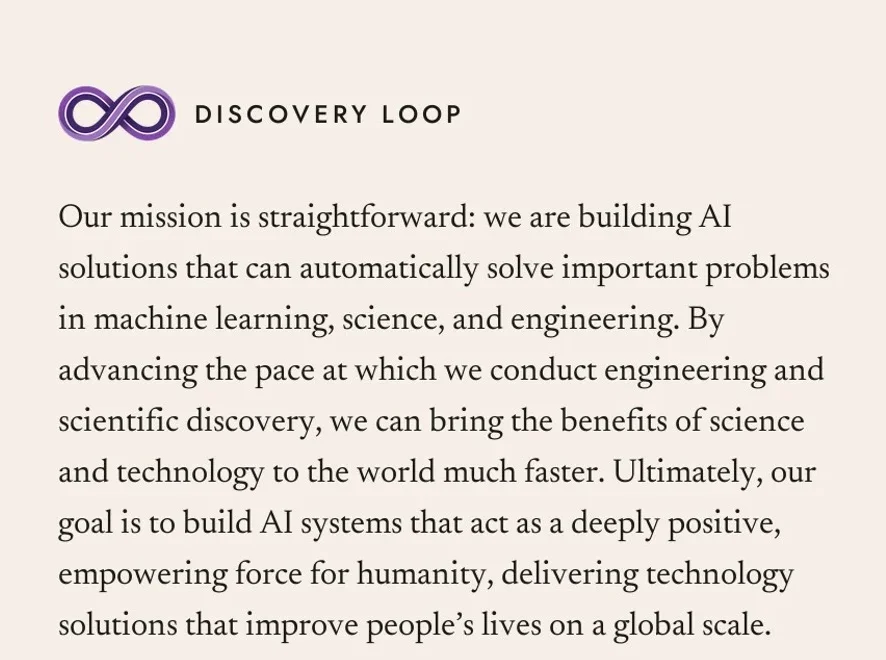
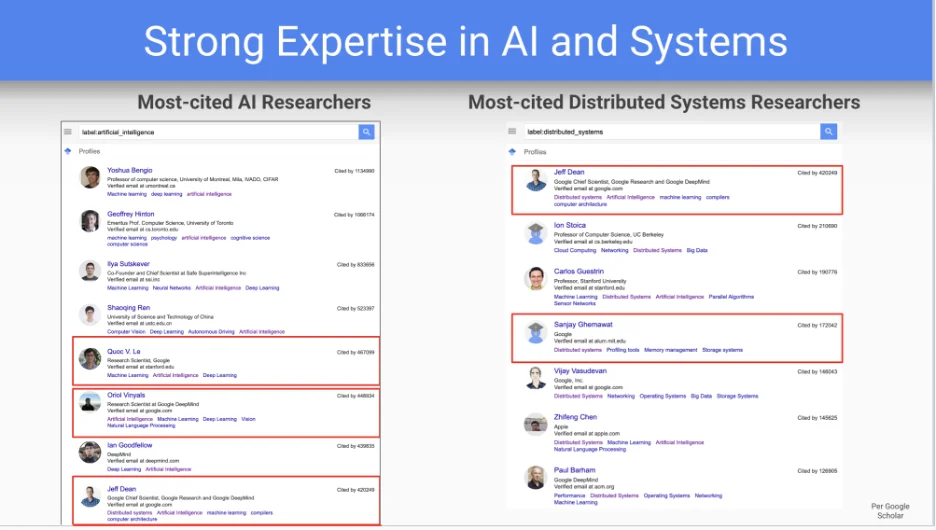
1/ Announcing Discovery Loop! I am very excited to announce that, along with my longtime friends and collaborators Sanjay Ghemawat, Quoc Le, and Oriol Vinyals, we are founding Discovery Loop, a Public Benefit Corporation whose mission is to automate machine learning, science, and engineering to accelerate discoveries and progress. The four of us have worked together for 14 to 30 years, and have helped build some of the world’s most used products, infrastructure and AI models, and we’re excited to turn our attention to this ambitious endeavor. 

Picture1

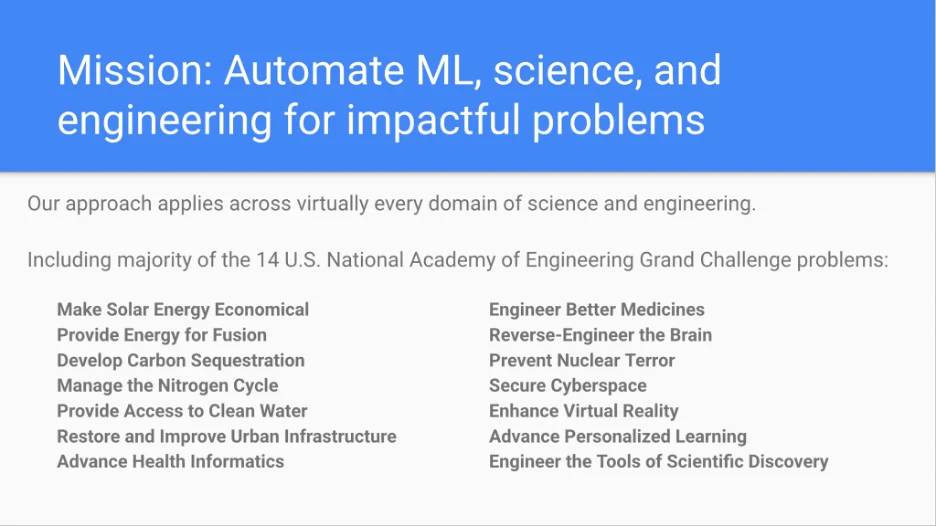
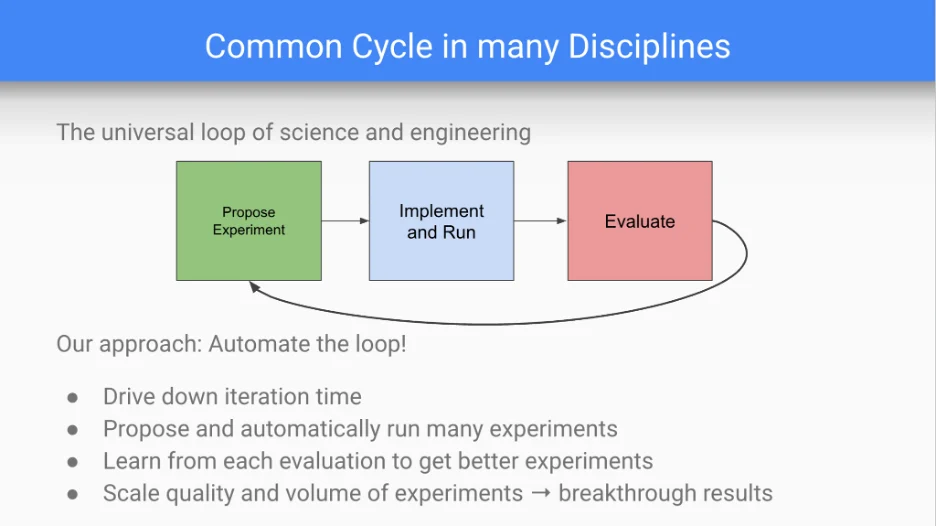
2/ Our general approach is to automate the experimental loop. We think this approach is broadly applicable across many different fields of science and engineering. We’ll initially focus on ML research and engineering, but believe the approach can help with important subproblems in nearly every one of the fourteen @NAE Grand Challenge problems. We think doing this well requires strong expertise in machine learning as well as large-scale systems.
Picture2

Picture3

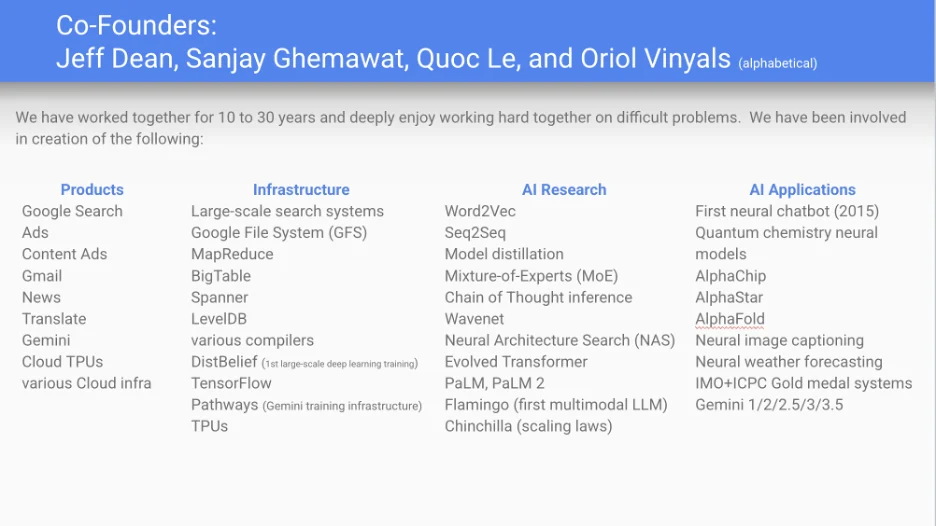
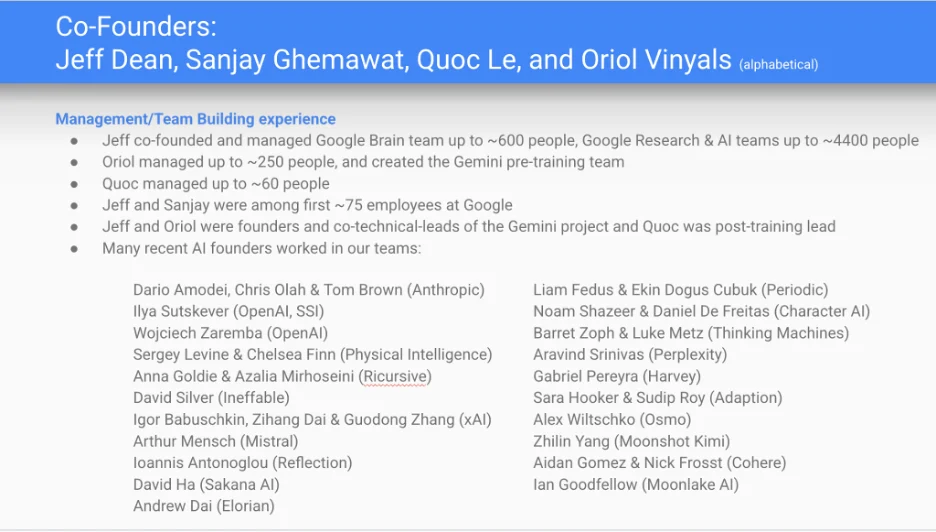
3/ We created a pitch deck to tell a handful of VC firms about us and what we were up to. Here’s a few slides about our background and some of the things we’ve worked on from the pitch deck (it was fun putting together the list of people in our teams who have gone on to found a whole range of exciting companies). We are delighted to have selected @radicalvcfund and @khoslaventures to lead our initial funding round, along with participation from @lightspeedvp, @kleinerperkins, Doerr Capital (@johndoerr), and Alphabet (@Google). We’ll be working with them to close our seed round over the next few weeks.
Picture4

Picture5

Picture6

4/ Our immediate order of business is to find office space, and hire an amazing founding team over the next few weeks. We want to create an awesome environment with a great culture of technical excellence, teamwork, respect, and ambition. We’ll also start building our infrastructure and AI models and systems to tackle our first domain: automating large-scale experimentation for ML research and engineering. In doing so, we’re going to be our own first customers. The rapid feedback from doing that is the way to build something amazing. Oh, we’re hiring! See discoveryloop.com

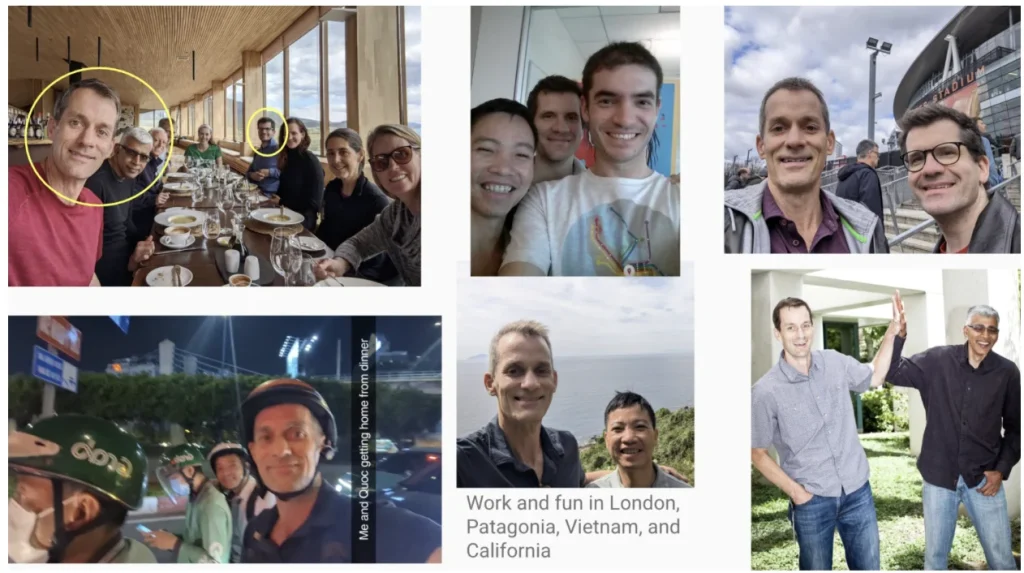
5/ One more fun slide from our pitch deck.
RR5

AI News This Week

  • Google Shakes Up AI Leadership as DeepMind Chief Shifts Role  (Reuters)

    Alphabet is executing a sweeping overhaul of its AI division as it battles mounting pressure from agile rivals like OpenAI and Anthropic. DeepMind CEO and Nobel laureate Demis Hassabis is relinquishing his primary managerial post to become Alphabet’s Chief Scientist, focusing entirely on the pursuit of artificial general intelligence and AI-driven drug discovery. As noted above, a cadre of legendary Google engineers—including Google Brain co-founder Jeff Dean and Oriol Vinyals—are departing to launch Discovery Loop, a public benefit corporation and Radical portfolio company. Alphabet is installing Koray Kavukcuoglu as Senior Vice President to lead day-to-day operations, signaling a sharp pivot away from pure research toward commercializing Google’s AI capabilities and steering Gemini in a strictly product-oriented direction.

  • Stanford HAI Says World Models Are AI's Next Governance Blind Spot  (Stanford HAI)

    A new policy brief co-authored by Radical Scientific Partner and founder of Radical portfolio company World Labs, Fei-Fei Li, alongside Stanford HAI’s Amy Zegart and Russell Wald, argues that world models pose a steeper governance challenge than LLMs because errors translate into physical harm, not just misinformation. The authors sort world models into renderers, simulators, and planners, and warn that the data needed to build them — robot trajectories, teleoperation logs, etc — cannot be scraped from the internet, creating steep barriers to entry that favor a handful of well-capitalized labs like World Labs.

  • Crusoe and Aalo Atomics to Build the First Nuclear-Powered AI Factory  (Crusoe)

    Radical Ventures portfolio company Crusoe has partnered with Aalo Atomics to pair a Crusoe Spark modular data center with Aalo’s small modular nuclear reactor at Idaho National Laboratory, targeting a 2027 proof of concept. Aalo, one of only four companies to reach criticality under the DOE’s Reactor Pilot Program deadline, plans to scale toward deploying its 50 MWe XMR power plants across Crusoe’s data centers by the end of 2029 — a concrete step toward solving AI’s power bottleneck with nuclear rather than gas or grid capacity.

  • AI and Quantum Computers Will Be Frenemies  (The Economist)

    Quantum computing and AI will complement each other’s development, overlapping in the problems they target and, eventually, helping each build the other. For example, quantum machines promise high-fidelity simulation of chemistry and materials, while AI firms chase the same targets through pattern recognition. Researchers argue the two close an optimization loop, since quantum simulations can generate the training data that sharpens AI predictions, which in turn point quantum computers at promising chemistry. AI can also help tackle quantum error correction, while quantum “reservoir” chips can accelerate AI training. 

  • Research: Why Vision Language Models Are Shortsighted   (Computer Vision Foundation)

    CLIP-based models have been reading like they’re skimming a headline and stopping there. A new CVPR 2026 paper finds that vision-language models trained on long captions latch onto the first sentence and largely ignore everything that follows, so retrieval accuracy collapses as soon as that opening sentence is moved or dropped. The fix requires no new parameters and no architecture change: strip the summary sentence during training, randomly sample the remaining ones, and pad the text so informative words land later in the sequence. The resulting model, DeBias-CLIP, holds its retrieval accuracy steady even when the summary is removed entirely, while prior long-caption models like Long-CLIP degrade sharply, and the same fix carries over to sharper detail retention in text-to-image generation.

    283fb017 02c1 2e05 6edd ded52017b79b

Radical Reads is edited by Ebin Tomy (Analyst, Radical Ventures)