
George Sivulka, CEO of Radical Ventures Portfolio company Hebbia, dives into why AI can beat us at chess and code but not at the stock market. George explores the current AI capability frontier and predicts which markets fall next. Below is an excerpt from his essay originally published on X.
AI has solved the Navier-Stokes problem, hacked our most secure systems, and designed new cancer treatments. It still can’t outperform the S&P 500. When will AI beat the market?
It’s a trillion-dollar question staring the labs in the face. The answer is surprisingly elegant. It begins with the 1991 construction of the world’s largest robot. Measuring 360 meters of steel, the Maeslantkering is the largest moving structure on earth. It operates completely autonomously. The Dutch know it as their floodgate, built to protect Rotterdam’s 2.7 million residents from deadly storm surges. To do its job, the robot must perfectly predict the sea level. The simplest model of sea level is a switch. When the tide is high, the switch is on. When the tide is low, it switches off.
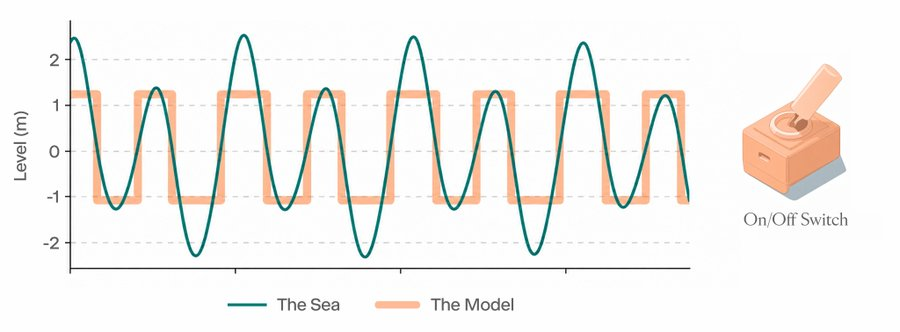
But the switch misses the shape of the tide. A rising tide still crosses the danger threshold.
The robot needs a better model.
The tide is largely driven by the moon, with its gravitational pull tracing a periodic curve on the oceans. Replace the switch with a sinusoid, and the robot’s prediction starts to trace the tide.
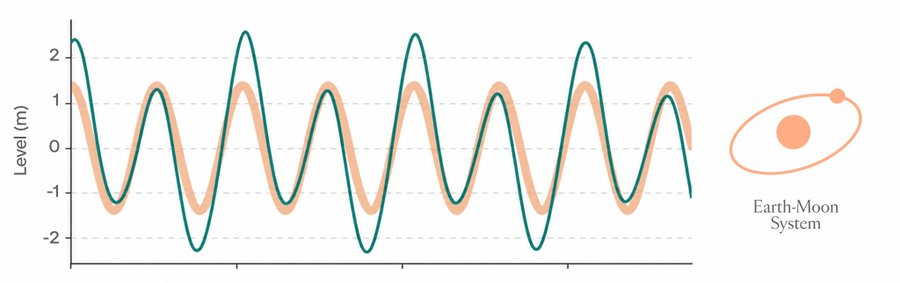
It’s still imperfect. The tide is also shaped by the Sun’s pull, the bay’s bathymetry, the orbit’s eccentricity, and dozens of other factors.
Only when the robot contains all relevant structure of the solar system can it predict the tides.
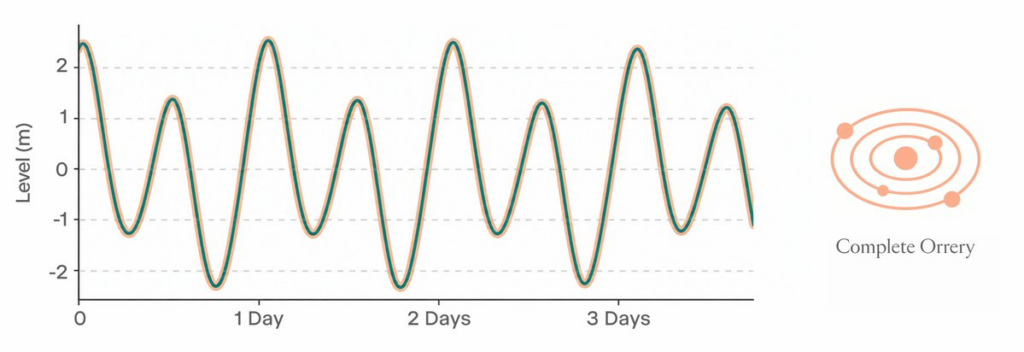
This exemplifies the Good Regulator Theorem, proved by Conant and Ashby in 1970: “Every good regulator of a system must be a model of that system.”
It perfectly explains AI’s capability frontier today:
- Chess models contain board geometry, reconstructed from move sequences.
- Coding agents contain the rules of computation, derived from every line of open source code.
- Video and world models contain physical laws, rederived from pixels.
AI is eating the world. But only in the order of what it can swallow.
Here’s the same gap between model and reality, redrawn for the stock market:
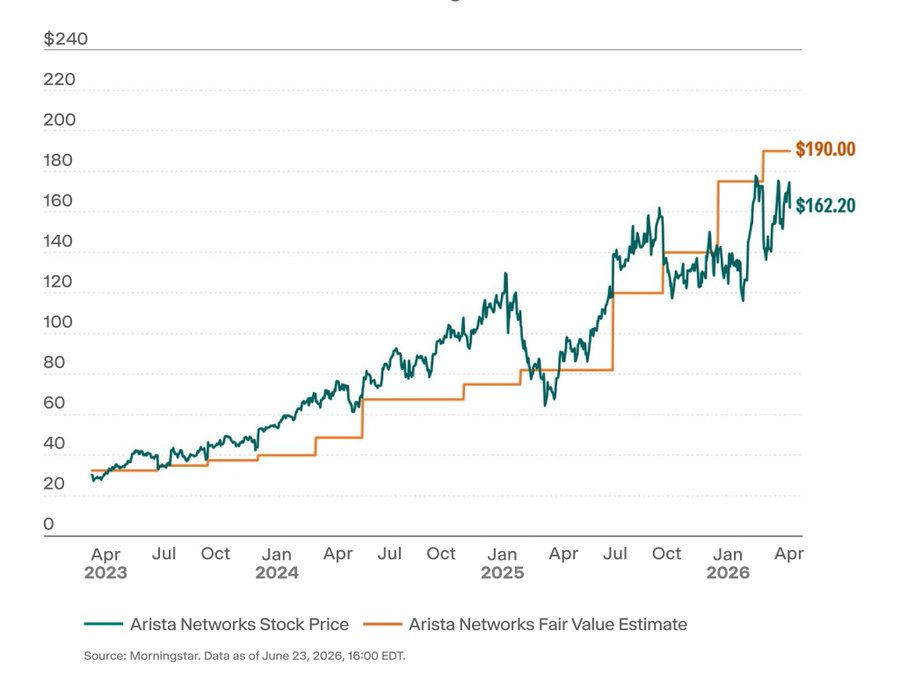
Clearly, Morningstar’s ‘fair value estimate’ is not a ‘good regulator’.
Perhaps Morningstar isn’t world-class at valuing stocks. But the same picture holds inside top decile hedge funds’ own internal price targets. Nobody has a good regulator for prices, and it’s due to a simple fact: Markets are self-referential, or as economists call them, reflexive systems.
Prices are set by millions of people watching the price, watching one another respond to the price, and responding in turn. Nobody has built an AI that contains the crowd.
Markets are falling in the order AI can contain them. But finance is still falling, and some markets are already contained. The theorem perfectly explains the order in which they fall:
1. The quants already built superintelligence.
2. The private markets will be public within a decade.
3. The public markets won’t be solved by an LLM.
Read George’s full essay for how he works through each of the three: why quant shops built the first financial superintelligence, what happens to private markets once the analyst bottleneck disappears, and why he thinks the best-positioned finance lab on earth is the one sitting on a social feed.
AI News This Week
- The Jobs Apocalypse is Postponed. An AI Jobs Boom is Here (Economist) — The Economist estimates the technology has added roughly 1M jobs in America, against some 200,000 layoffs attributed to it since mid-2023. Data-centre construction, running above $75 billion a year, is pulling in electricians, HVAC specialists and grid engineers at wages about 40% above comparable work, while postings for AI engineers and heads of AI have roughly doubled since 2023. Paralegals and market-research analysts, long seen as vulnerable, have grown faster than the national average. Routine administrative work is the exception, with secretarial employment down about 15%.
- How Big is the Open-Model Threat to AI Hyperscalers? (FT) — Enterprise AI spending is shifting toward model companies that can run themselves. Model routing firm OpenRouter reports that the share of queries sent to closed proprietary models fell from three-fifths at the start of the year to roughly a quarter, and AT&T now runs 40% of its AI usage on open models, saving up to 80%. Confidentiality is the second driver, with Latham & Watkins buying Nvidia hardware to fine-tune open-weight models on client data it will not send to a cloud vendor. Companies like Radical Ventures portfolio company Cohere serve this demand, releasing open weights through Cohere Labs and deploying privately for regulated industries.
- AI Has Solved One of Math’s $1 Million Millennium Prize Problems (Quanta) — An AI system has settled one of the Millennium Prize Problems, the seven hardest questions in the field of mathematics, each carrying a $1 million prize. OpenAI released a 165-page proof, with step-by-step formal verification, showing that smooth three-dimensional fluid motion can develop a singularity in finite time, the central question behind the Navier-Stokes existence and smoothness problem. Roughly 10,000 agents ran for about 88 hours, costing millions of dollars in compute. The finding has sparked controversy. An NYU mathematician who was racing to the same result using OpenAI’s own tools says the company may have built on his unpublished work, which OpenAI denies.
- Medicine Needs to Get Serious About AI (Atlantic) — The debate over clinical AI is shifting from whether physicians should use it to whether they should always control it. The authors argue that much of medicine is algorithmic enough for autonomous models to be tested directly against doctors, citing a randomized trial in which AI reached stable insulin doses faster and with better patient adherence, and a review of 52 studies finding human-AI hybrids performed no better than AI alone. The American College of Physicians has since allowed fully autonomous AI for low-risk, low-complexity decisions, showing how rapidly AI adoption is occurring in healthcare.
- Research: Language Models Can Control Their Own Attention (KAIST AI /DeepMind) — Every time a model produces a word, it scans its entire context again, even though only a small part of it is relevant. A technique called Declarative Attention asks the model to say which part it needs before each step of its reasoning, marking whether it is searching the full document, reading a single section, or working from what it has already written. Across 15 long-context tasks, two off-the-shelf models read 31% and 52% less while answering nearly as accurately, and the accuracy cost shrank as the models got larger.