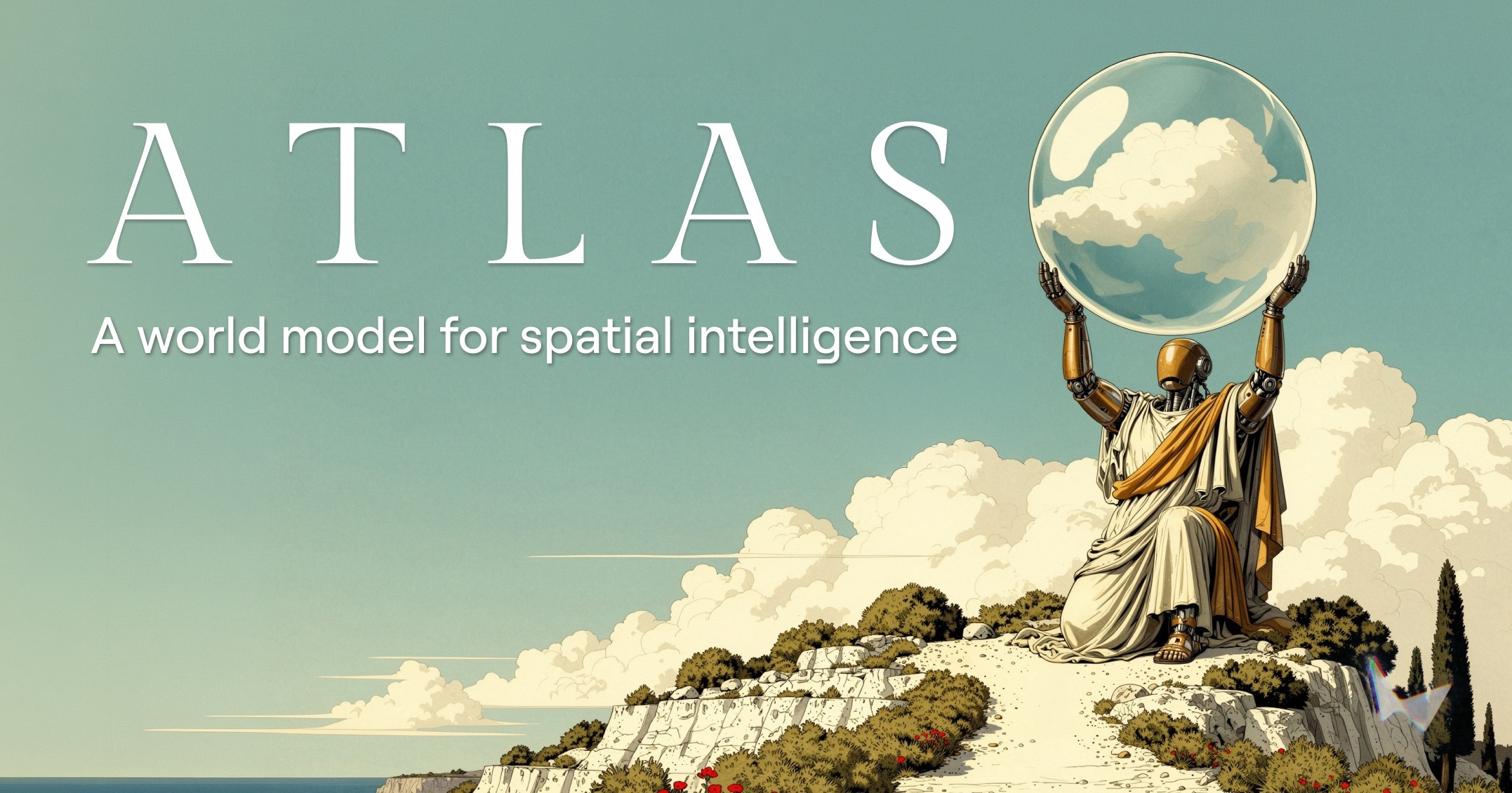
This week, Radical Ventures portfolio company World Labs released Atlas, its next-generation world model for spatial intelligence.
Atlas is a single model pretrained from scratch on text, images, video, and 3D. It combines every input into a shared spatial context, then generates what comes next while staying consistent with everything it has already seen. That design lets one model take on world generation, reconstruction, and simulation, work that has usually been split across separate specialized systems.
The model produces minute-long videos at 1440p with precise camera control, reconstructs real-world scenes from as few as two or three photographs, and simulates how a space changes over time for uses including robotics and visual effects. World Labs reports that Atlas outperforms models purpose-built for camera-controlled generation and for 3D reconstruction, and that its performance keeps improving as training compute grows. Atlas is an incredible leap forward for spatial intelligence, and will power future versions of Marble and other World Labs products.
Watch their release video below and read more about Atlas on the World Labs blog.
AI News This Week
- This City Is One of the World’s Most Important AI Hubs. It’s Not Where You’d Expect (CNN) — Geoffrey Hinton left a post at Carnegie Mellon in the 1980s to pursue machine learning at the University of Toronto, and the students he trained became leaders of a generation of modern AI leaders. That work built an ecosystem around the university and the Vector Institute, a leading deep learning research institute Hinton co-founded alongside Radical Ventures co-founders Jordan Jacobs and Tomi Poutanen. This CNN feature unpacks this story and features several Radical portfolio companies anchored in the Toronto ecosystem. Nick Frosst studied under Hinton and worked at his Google Brain Toronto lab before co-founding Cohere, and Raquel Urtasun was a University of Toronto professor and Vector co-founder who ran Uber’s Toronto self-driving lab before founding Waabi. Gennady Pekhimenko, a University of Toronto professor and Vector faculty member, built Radical portfolio company CentML before selling it to Nvidia.
- OpenAI’s Next Big AI Model Has ‘Entered the AGI Era’ (Verge) — The release of GPT-6 Astra marks the first time a frontier model has been designated as crossing a critical cybersecurity threshold, meaning it is judged able to find and exploit vulnerabilities in well-protected systems without human guidance. Labs now gate this class of model, limiting access to trusted defenders for work like vulnerability validation and malware analysis. Astra arrived just two months after OpenAI’s previous update, showing that release cycles are shrinking as frontier labs turn AI on its own development, with earlier models helping supervise the training of newer ones.
- Nvidia’s Hugging Face Acquisition Is a $12.9 Billion Bet on Open-Source AI (Wired) — Nvidia agreed to acquire Hugging Face, which hosts open-source AI models and datasets, for nearly $13 billion, pledging to keep its open standards. The shift carries clear tailwinds for open source. As cheap, post-trainable open-weight models let companies and governments own their intelligence rather than rent it, more will build their own models using tools that automate parts of the training stack. Several Radical Ventures portfolio companies work across that stack, including Datology on data curation, Prime Intellect on reinforcement-learning-driven post-training, and Cohere on the open-weight models enterprises can run and adapt within their own environments.
- Will Anybody Use AI as Much as Coders Do? (Economist) — Software engineers are the heaviest users of AI, with four-fifths of developers already using an AI coding tool. According to estimates, coding accounts for more than half the combined recurring revenue at Anthropic and OpenAI. Legal, finance, and customer-service tools are growing fast, but coding benefits from abundant training data, testable output, and engineers who build or adopt AI tools to get work done.
- Research: A World Model for Spatial Intelligence (World Labs) — This deeper dive looks at the innovations behind World Labs’ new Atlas spatial intelligence model. Rather than flattening inputs into a sequence like most models, Atlas anchors every image to a position in 3D space, a spatial context that keeps generated views geometrically consistent, so the model can imagine the back of a robot or the room beyond a doorway without the scene drifting. Camera angle is a native input, letting users frame exact shots instead of describing them in text. The architecture blends the autoregressive approach of language models with the diffusion methods of video models. World Labs reports it outperforms specialized systems at generation and 3D reconstruction.