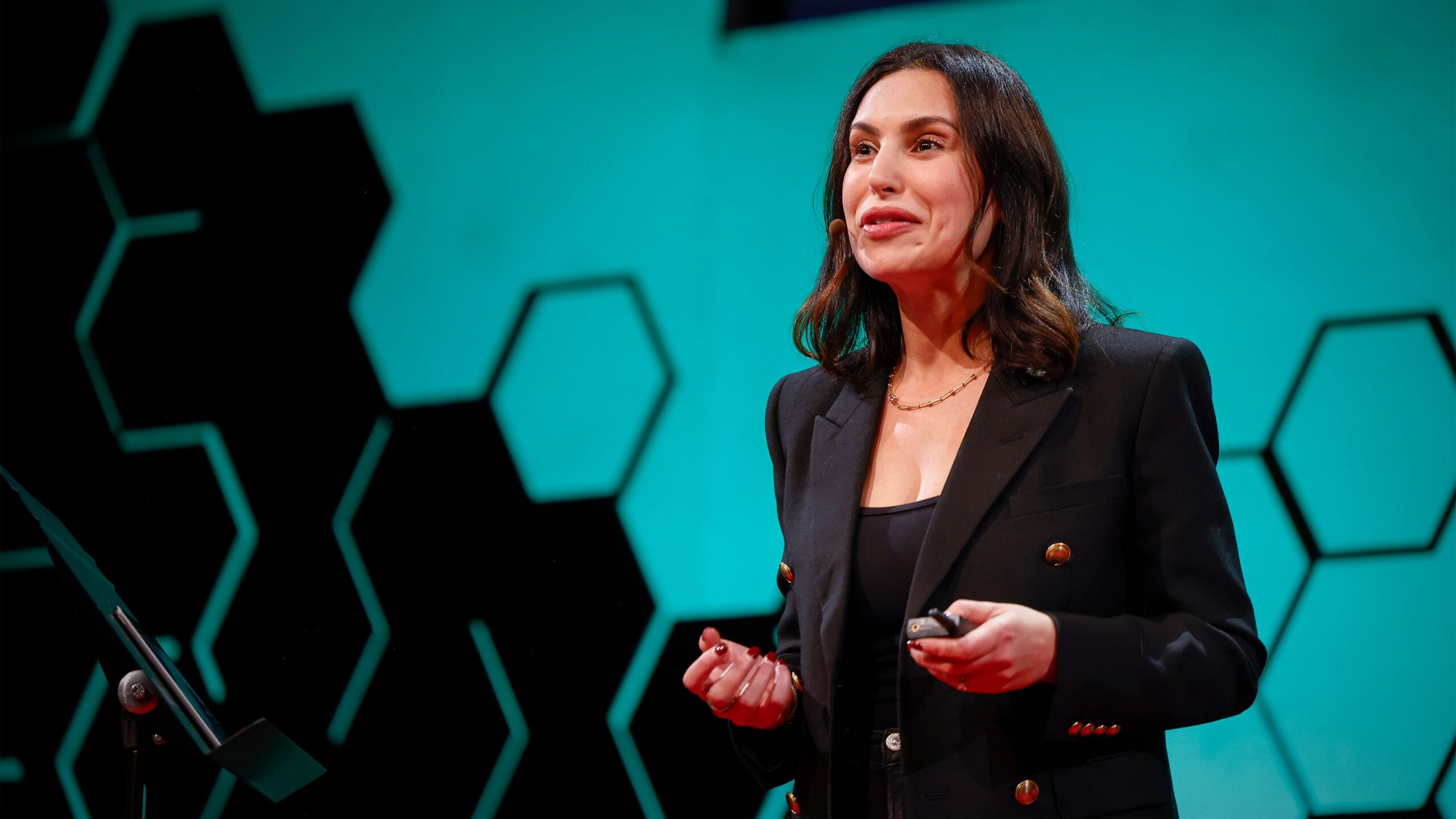
In her recent TED talk, May Habib, Co-founder and CEO of Radical Ventures portfolio company Writer, argues that AI represents a shift from execution as a scarce, expensive resource to one that is programmatic and abundant. May outlines the opportunity for leaders to address bureaucratic complexity by moving from optimizing existing workflows to reimagining what becomes possible when ambition is the only constraint. This week, we share May’s talk on the rise of the AI-native leader.
AI News This Week
-
TIME100 Most Influential Companies 2026: Emerald AI (Time)
Radical Ventures portfolio company Emerald AI was named to TIME magazine’s 100 Most Influential Companies list. Emerald has developed a software platform that orchestrates when and where AI workloads run based on real-time energy grid conditions, turning data centers into flexible energy loads rather than fixed drains on power infrastructure. Founder and CEO Varun Sivaram frames energy as the binding constraint on AI progress, making clear that unlocking grid capacity is the fastest path to scaling AI infrastructure.
-
The AI Supply Crunch is Here (Economist)
Token consumption quadrupled in the first quarter of 2026, and the AI industry cannot keep up. Frontier labs are rationing capacity as data centres, transformers, and chips remain in short supply. The squeeze is reshaping the economics of AI. Hyperscalers with the deepest balance sheets are locking up hardware, while choke points in the supply chain concentrate profits at firms like Nvidia and TSMC, where gross margins now exceed 60%.
-
How AI is Powering the Next Generation of Robotaxis (FT)
Foundation models have become the backbone of self-driving cars, allowing them to generalize across new cities and predict human behaviour in unseen scenarios. Current approaches include pairing a visual language model that interprets the road with a decoder that predicts how others will respond, both fed by a constant stream of real-world data, creating a self-improving loop. AI-first leaders like Radical Ventures portfolio company Waabi, which has partnered with Uber to deploy at least 25,000 robotaxis using Waabi’s AI, are betting that end-to-end models trained primarily in simulation will scale across geographies and form factors more efficiently than incumbents.
-
Big Tech's $700 Billion AI Spending Spree Has No Clear End in Sight (Fortune)
Big Tech reported earnings this week, and AI infrastructure spending is on track to approach $700 billion this year, more than triple 2024 levels. Combined Q1 capital expenditures from Alphabet, Amazon, Meta, and Microsoft exceeded $130 billion, earmarked for the build-out of data centers, GPU clusters, and high-speed networking infrastructure. McKinsey projects that $5.2 trillion in global data center capex will be needed for AI workloads by 2030.
-
Research: Autogenesis - A Self-Evolving Agent Protocol (Nanyang/Stanford/CityUHK/Princeton)
Researchers introduce Autogenesis, a protocol for agents that safely rewrite themselves as deployment environments and tools change. The architecture separates a substrate that standardizes access to prompts, tools, and memory from an evolution layer that runs a closed loop of reflection, proposal, evaluation, and commit, with every modification versioned and reversible. Recursive self-improvement, long an aspiration in AI research, is moving from ad hoc prompt tweaks to a disciplined practice in which changes are auditable and safe to deploy.
Radical Reads is edited by Ebin Tomy (Analyst, Radical Ventures)