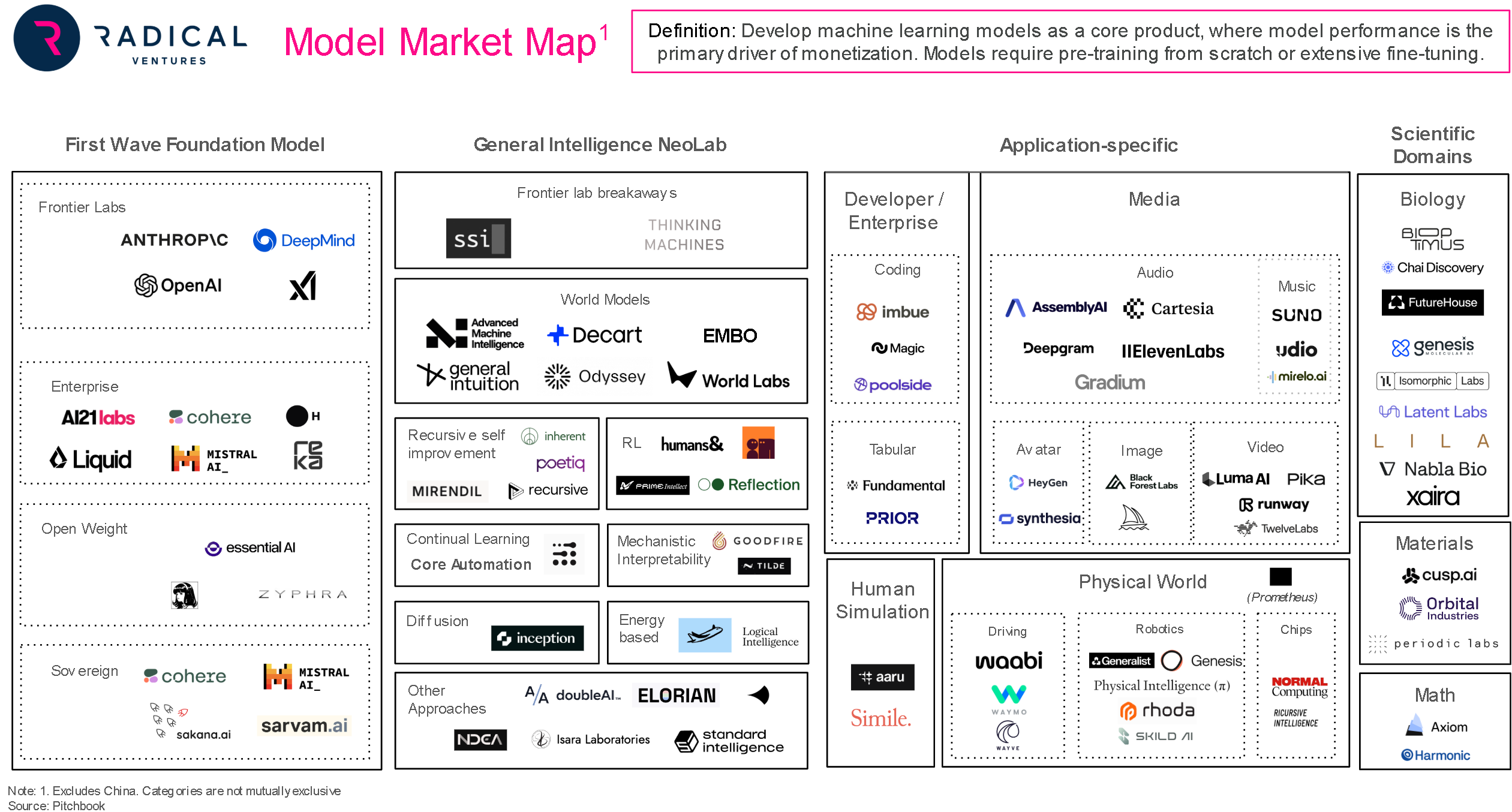
This week, Radical Ventures announced our lead investment in Decart‘s $300M Series B round, joined by our frequent co-investor Nvidia, along with Sequoia Capital, Benchmark, Atreides and a number of other strategic and financial investors. I will join the board alongside the founders, Sequoia and Benchmark.
Decart has built a state-of-the-art real-time generative video platform combining frontier world models with a chip optimization software stack that makes real-time video generation commercially viable at a massive scale.
AI has advanced rapidly in the domain of language. Large language models can reason, write, and code with increasing sophistication. To move AI into the physical world, systems need to model environments that persist and react according to real-world dynamics. World models represent this next frontier, and Decart is building both the SOTA generative video models and one-of-a-kind systems-level infrastructure required to run them in production, in real-time, at scale and at a fraction of the cost previously possible.
At the core of the company is the Decart Optimization Stack (DOS), a vertically integrated platform spanning hardware-aware model design, kernel tooling, proprietary compilers, and inference optimization. DOS is hardware-agnostic, so it can run across NVIDIA GPUs, Amazon Trainium, and Google TPUs, and integrates directly into a customer’s existing infrastructure. DOS delivers over 1,600 tokens per second for agentic inference, compared to an industry average of roughly 200, and powers full-HD video and world model inference at up to 100 frames per second. In an industry where most workloads waste a significant share of the hardware they run on, Decart’s systems achieve more than 80% Model FLOPS Utilization on Trainium, meaning more of the chip’s raw power is doing real, productive work.
Decart’s model suite operates on top of this infrastructure. Lucy, its world model for immersive experiences, is the only real-time generative video world model running at scale in production today, powering live deployments across commerce, virtual clothing try-on, dynamic advertising, live streaming, and gaming. Lucy transforms video and environments in real-time, responding to user input in under 30 milliseconds.
Oasis, Decart’s world model for Physical AI, generates interactive, physically accurate, real-time simulations for applications in robotics and autonomous systems. Both models are available to customers via API.
Decart’s CEO, Dean Leitersdorf, was the youngest ever PhD graduate from Technion at age 23. That is until his brother Orian (Decart’s CTO and co-founder) completed his Technion PhD at age 21. Along with co-founder Moshe Shalev, the Decart team comprises optimization experts, AI and computer science prodigies, and elite systems engineers who have built a platform that bridges the gap between research and deployable products. While the AI industry broadly assumed real-time, production-grade generative video world models were years away, Decart has made them a commercial reality, with Amazon as an early anchor API customer across multiple product lines. The applications across live streaming, media, gaming, advertising, commerce, and robotics are vast, but the thesis is simple: Decart has built the foundational software that makes this entire category of real-time generative video possible at scale.
We are excited and proud to partner with Dean, Moshe, Orian and the entire Decart team as they enable the next era of Gen AI.
You can read more about Decart’s new round of fundraising in the Wall Street Journal or on the company’s blog, and watch Dean’s interview on TBPN.
AI News This Week
-
CNBC Disruptor 50: Waabi (CNBC)
Radical Ventures portfolio company Waabi is again on CNBC’s 2026 Disruptor 50 list. The company’s self-driving trucks are already running commercial freight routes in Texas for Uber Freight, Samsung, and other Fortune 500 clients, with fully driverless operations expected by year-end across the U.S. Southwest. Waabi is also developing a “shared brain” architecture that applies across both freight trucks and robotaxis, and has entered a partnership with Uber to power the deployment of 25,000 Uber robotaxis.
-
Inside Incyte’s $120 Million AI For Drug Development Deal (Forbes)
Radical portfolio company Genesis Molecular AI announced a $120 million partnership with Incyte that could exceed $1 billion with milestone payments and royalties. Genesis will train its foundation model using Incyte’s data to identify targets and drug candidates across oncology, hematology, and inflammation. The partnership follows Genesis’ earlier deals with Gilead and Eli Lilly to deploy the Genesis AI platform to enable discovery of medications to treat and cure disease.
-
Do Job Postings Show Early Labour-Market Effects of AI? (Federal Reserve)
Research from the NY Federal Reserve shows that although overall hiring in the U.S. has slowed since the release of ChatGPT in late 2022, there is little evidence that AI is a major contributing factor. By analyzing job posting data and different occupations for their susceptibility to being automated by AI, the authors show that AI exposure of vacancies remains relatively limited. The divergence between high and low AI exposure occupations began before the release of ChatGPT, suggesting AI has had a limited causal effect on hiring. Even within fields with high AI exposure, there was no divergence in labour demand for junior and senior positions, indicating little evidence to support the theory that AI is the main driver of the recent slowdown in entry-level hiring.
-
How Chinese Short Dramas became AI Content Machines (MIT Technology Review)
China’s $6.9 billion short drama industry offers a window into how AI is reshaping content production at scale. Studios that once spent three to four months producing a series can now do so in under a month, with costs cut by 80–90%. The shift has also created new roles, including “AI asset curators” who translate scripts into prompts and generate visual assets.
-
Research: Autonomous AI research for Nanogpt Speedrun (Prime Intellect)
AI systems are becoming capable research engineers, but not yet research scientists. Prime Intellect tested two leading AI coding agents on an autonomous machine-learning research challenge, allowing them to run experiments freely for two weeks across thousands of GPU-hours. Both beat human benchmarks through systematic experimentation and relentless optimization. But every meaningful advance came from techniques human researchers had already published. These results show the lower bound of what autonomous research agents can do today, with more promising recursively driven agents in development.
Radical Reads is edited by Ebin Tomy (Analyst, Radical Ventures)