
This week, Radical Partner Rob Toews shares five new predictions on what the world of AI will look like in the year 2030. We share brief excerpts from each prediction below. Read the full article in Forbes.
- Anthropic will be one of the largest and most important life sciences companies in the world.
One of Anthropic’s great strengths compared to its archrival OpenAI is its maniacal focus.
From its earliest days, Anthropic identified coding as the most important domain in AI to focus on. While OpenAI pursued a sprawling set of ambitions, from video AI to consumer hardware to chips to robotics and beyond, Anthropic’s laser focus on coding enabled it to build the most powerful coding models in the world, setting the stage for the breakout success of Claude Code. Anthropic’s jaw-dropping recent growth—from $9 billion in annualized revenue at the end of 2025 to $47 billion in annualized revenue as of last month—has been driven primarily by demand for AI coding.
But Anthropic’s ambitions as a company are bigger than coding. What will be the next domain that Anthropic commits itself to and goes all in on?
In recent months, it has become clear that the answer is biology.
- TSMC’s and ASML’s monopolies will be broken. The semiconductor supply chain will be dramatically transformed.
The semiconductor industry is, in short, one of the most monopolistic and concentrated sectors on earth. This concentration introduces great fragility and global risk.
The semiconductor industry is also one of the most supply-constrained sectors on earth. Demand for powerful chips has become essentially infinite thanks to the AI boom—yet the global supply of AI chips remains capped by how many EUV lithography machines a single company (ASML) can crank out, and by how much fab capacity one other company (TSMC) has available.
This market structure is a suboptimal and unstable equilibrium. And it represents a massive opportunity for entrepreneurs and technologists seeking to disrupt established incumbents in one of the world’s largest markets.
Time and time again in the history of technology, monopolistic industry leaders that long seemed invincible—from Xerox to IBM to AT&T—have proven vulnerable to agile upstarts and technology advances that broke markets wide open by lowering costs, expanding supply and leapfrogging capabilities.
We predict that, by 2030, we will see this story playing out in the chip industry.
There are already early signals as to what this might look like.
- Telepathy will be a well-established way to communicate.
Telepathy is the ability for one person to communicate with another person using only his or her thoughts.
Telepathy has long resided in the realm of science fiction and fantasy, from X-Men’s Professor X to Star Trek’s Vulcan mind meld to Stranger Things’ Eleven.
But as Arthur C. Clarke famously observed: “Any sufficiently advanced technology is indistinguishable from magic.”
In the half-decade between now and 2030, we predict that the concept of telepathy will make the leap from the realm of magic to the realm of real technology.
How will this be possible? In short, dramatic advances in brain-computer interface (BCI) technology.
- AI will consume much less energy than it does today.
Last year, former Google CEO Eric Schmidt testified before U.S. Congress that AI would eventually consume 99% of the world’s electricity.
By 2030, it will be clear how misguided and implausible this point of view is.
Schmidt can be forgiven for making this headline-grabbing prediction. Today’s AI consumes a staggering and rapidly growing amount of energy. Schmidt is hardly alone in naively extrapolating this trend out and concluding that, in the limit, AI will inevitably consume all the energy in the world.
What this line of thinking misses is that, in retrospect, today’s approach to AI will prove to be astonishingly resource-inefficient.
…
The human brain is the ultimate existence proof that intelligent systems that are vastly more energy-efficient than today’s AI are physically possible. And given that such systems are physically possible, powerful economic and strategic incentives exist for technologists and entrepreneurs to build them.
Let’s pause here to make an important clarification about this prediction. We are not predicting that the aggregate amount of energy used by AI will be lower in 2030 than it is in 2026. What we are predicting is that AI will require a tiny fraction of the power that it requires today—perhaps millions of times less—to complete any given task. We predict that the field of AI will be well on its way to matching the resource efficiency that biology has achieved with the human brain.
- The question of whether AIs deserve legal rights and protections will be a mainstream societal and political debate.
As AI models continue to get more powerful in the years ahead, the depth, richness and authenticity of their personalities—and the strength of the ties that humans form with them—will only increase.
Moreover, over the next few years, humanoid robots (AI-powered robots shaped like humans) will begin to populate our world, from workplaces to schools to hospitals to homes. Having a physical embodiment, especially one that resembles a human, will further endow AIs with a sense of identity and relatability.
Inevitably, we will find ourselves confronting the question: is it appropriate for us to continue treating these entities as mere objects? Or might they be deserving of certain rights and protections?
…
It is impossible to predict exactly how our ethical conceptions and our legal frameworks will evolve in the years ahead as AIs come to populate our world and lives.
To be clear, we are not predicting that legal rights like these will be unanimously supported nor broadly implemented by the year 2030. But we do predict that the Overton window on this topic will shift dramatically. By the end of the decade, these issues will be actively and fiercely debated in mainstream society—in the courtroom, on the campaign trail, in the media, around the dinner table. It will be a fascinating and mind-bending time for technologists, policymakers, ethicists and everyday citizens.
Read Rob’s full piece in Forbes.
Join Radical’s 6th Annual AI Founders Masterclass and Compute Program
Applications are now open for the 2026 AI Founders Masterclass — our annual four-week virtual program for AI researchers and technical entrepreneurs, running October 7–28. This year’s speakers include luminaries Yann LeCun, Aidan Gomez, and Anna Goldie, among others. The program is designed for researchers, students, and technical founders looking to make the transition to launching a startup, with the opportunity to learn directly from those who have done it before. Participants also have an opportunity to apply to our selective Compute Cohort, which provides accepted founders with up to $250,000 in compute credits, mentorship from our team, and more. Spots are limited. Apply here: https://radical.vc/masterclass/
AI News This Week
-
AI-For-Health Care Startup Signal 1 Takes Off as it Borrows Page from Shopify and Slack (Globe and Mail)
Hospitals are deploying AI at unprecedented scale, with leading systems already running over 100 tools across diagnostics, predictive care, and agentic workflows that draft notes and send pharmacy orders. Radical Ventures portfolio company Signal 1, co-founded by Radical Partner Tomi Poutanen, provides hospitals with the infrastructure to govern, monitor, and safely optimize their growing AI footprint. Mount Sinai’s seven-hospital system in New York adopted Signal 1’s platform this week, joining others including Inova Health System in Washington, D.C., a major US East Coast academic medical center, Nova Scotia Health, and Trillium Health Partners.
-
How the DeepMind Mafia Brought the AI Boom to London (FT)
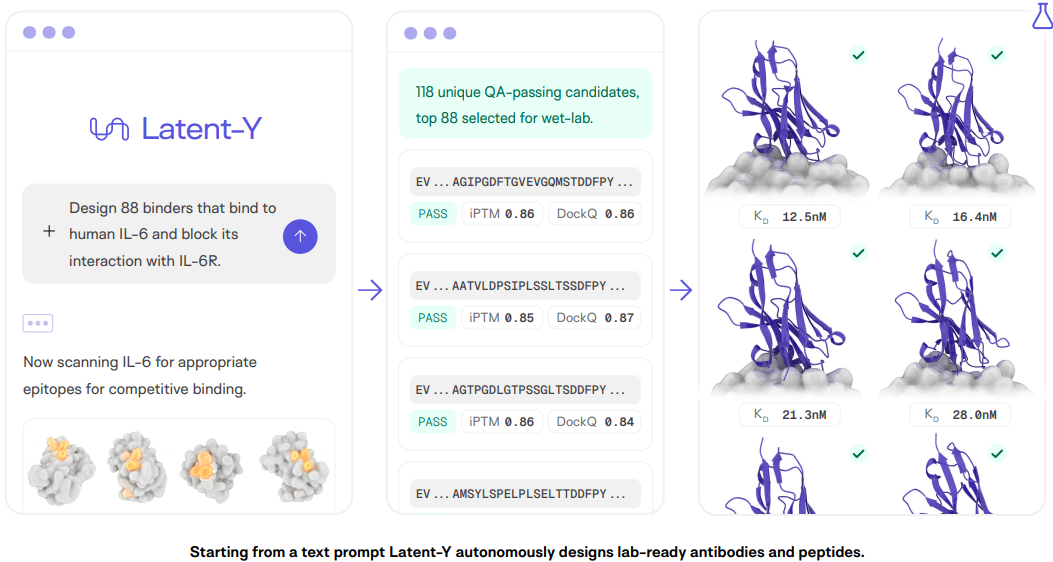
London has emerged as Europe’s center of gravity for AI, with King’s Cross hosting outposts of major frontier AI labs and application startups. Much of the activity traces back to DeepMind alumni, who have collectively raised $55 billion globally. Radical Ventures has been investing in London since 2023, where our Partners Aaron Rosenberg, formerly Head of Strategy and Operations at DeepMind under DeepMind CEO Demis Hassabis, and Rich Kotite, previously at Accel and Google, are based. Radical has partnered with leading DeepMind alumni, including the teams behind Inherent, Latent Labs, Orbital Industries and companies soon to be announced.
-
Why the Memory Crunch Is Almost Impossible to Solve (WSJ)
Memory has joined GPUs and power as a structural constraint on AI’s growth. The three producers that dominate DRAM (Samsung, SK Hynix, Micron) are routing capacity to AI customers paying premiums for high-bandwidth memory used in training and inference. Memory makers remain cautious about expanding given prior boom-bust cycles, and new US fabs won’t open until 2027 and 2030, suggesting the constrained supply may persist for some time.
-
Why Big AI Labs are Hiring so Many Philosophers (Economist)
As frontier models take on more autonomous decision-making, the technical questions of model behaviour have become indistinguishable from philosophical ones. Applications of philosophy in AI include the Socratic method to reduce sycophancy in AI models, “Socratic ignorance” to limit hallucinations, and AI constitutionalism, where models are built around scaffolding drawn from sources ranging from Kant to the Universal Declaration of Human Rights. Two ethical frameworks dominate deployment choices, with rule-based models better suited to emotional support and home robotics, and tradeoff-weighing models central to autonomous vehicles and defence systems.
-
Research: From AGI to ASI (DeepMind/University of Waterloo/UCL/Australian National University)
Researchers examine how the field might transition from today’s general intelligence systems to artificial superintelligence (ASI), defined as systems that exceed large collectives of human experts across virtually all tasks. The paper maps four pathways: continued scaling of compute and data; an algorithmic paradigm shift on the order of the Transformer; recursive self-improvement, where AI systems design their own successors; and group agent formation, where coordinated populations of general intelligences produce capabilities greater than the sum of their parts.
Radical Reads is edited by Ebin Tomy (Analyst, Radical Ventures)