Radical portfolio company Latent Labs has launched Latent-Y, the first lab-validated autonomous drug design agent, for researchers worldwide. Simon Kohl, Founder and CEO of Latent Labs and former co-lead of DeepMind’s protein design team, explains what changes when frontier design is in the hands of the people running the experiments.
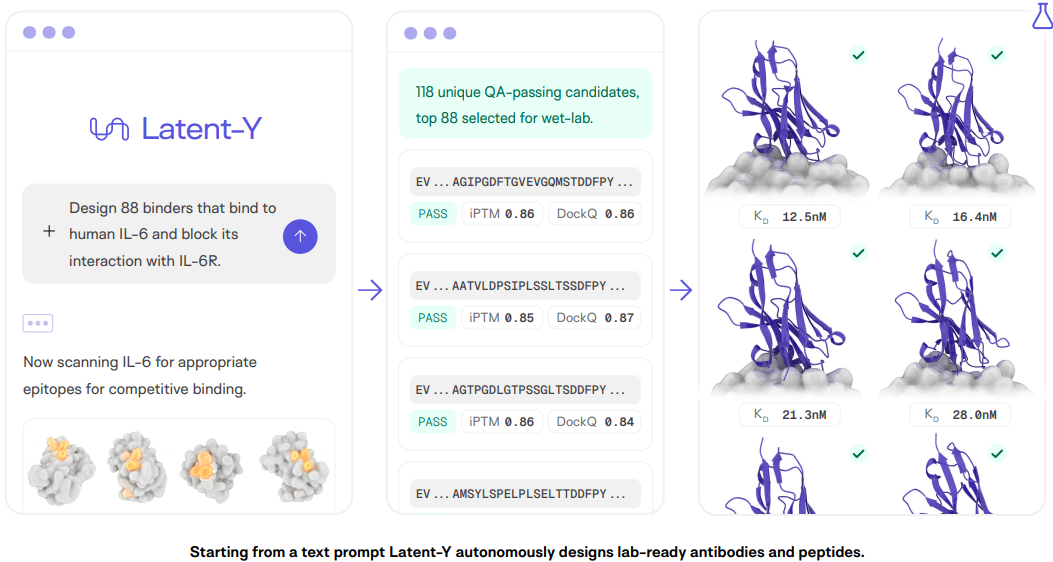
Drug discovery has always been constrained by expert time. Designing a viable binder takes weeks of specialized work, and few labs have a protein designer who can do it. Latent-Y removes that constraint, turning a plain-language goal into lab-ready candidates by working through target analysis, epitope selection, and refinement the way a specialist would.
Ahead of the launch, we gave early access to groups spanning ion channel biology, cancer immunotherapy, and infectious disease, including some with no computational design experience. The response was extraordinary.
A UC Davis lab generated nanobody inhibitors for one of the field’s hardest targets (a human ion channel) from scratch, with most candidates working on the first attempt. A group at LMU University Hospital in Munich built designed binders to generate cancer-killing immune cells, which have now moved into animal studies. And a researcher at the Broad Institute tackled a cancer-linked target with no existing treatment, work that would normally need a dedicated computational team his lab lacks.
In our published results, Latent-Y achieved a 67% target-level success rate across nine targets and completed campaigns 56 times faster than independent expert estimates. Given only a scientific paper to work from, the agent correctly identified the target site every time.
Every approved researcher receives a free daily quota of 250 designs, with more available on demand. Just as coding agents accelerate software development, Latent-Y lets one person run dozens of campaigns in parallel, each with expert-level reasoning, all from a single prompt. We built this tool to be a force multiplier for researchers, for a future where designing a drug looks less like a years-long experimental endeavour and more like a search query on the web.
Read our full technical report and blog post for more details on these results, and apply for access yourself at platform.latentlabs.com.
AI News This Week
-
Will Cheap Specialised AI Models Threaten the Big Tech Chokehold? (FT)
Fine-tuning cheaper models on a company’s own data and expertise can produce durable advantages over frontier models within a narrow domain. The edge came from proprietary judgment the generalist models cannot access, suggesting a longer-lived advantage and a possible new layer of companies like Radical Ventures portfolio company Prime Intellect that help companies build and maintain bespoke models. For example, Prime offers a full stack for agent development, spanning compute access, a reinforcement learning framework, environments, and evaluation tools. This approach lets enterprises become their own AI lab, refining models on their own workflows to compete at the frontier at a fraction of the cost.
-
DeepMind CEO Calls for an Independent Standards Body to Regulate Frontier AI (TechCrunch)
Demis Hassabis, CEO of Google DeepMind, used an essay on X to propose a US-led standards body that would test frontier AI models before release. Labs would first share models voluntarily for review up to 30 days ahead of launch, with testing focused on cyber, biological, and deception risks, and passing the assessment would become a requirement for US deployment once the protocol proved robust.
-
CRISPR gets a Power Boost from AI-Designed ‘Molecular Scissors’ (Nature)
AI protein design is beginning to outdo evolution at building the enzymes behind gene editing. Researchers used AI models to create synthetic CRISPR enzymes that edit the genome more efficiently than their natural counterparts. Until now, scientists could alter these enzymes by only 1–2% before they stopped working, which capped how far the technology could move beyond what nature already produced. The AI-designed versions differed by as much as 30% yet still edited genes successfully in bacterial, plant, and human cells, with some outperforming the originals.
-
Anthropic Found a Hidden Space Where Claude Puzzles Over Concepts (MIT Tech Review)
A new interpretability method is giving researchers a clearer read on what a language model computes internally before it produces an answer. Anthropic built a tool called the Jacobian lens to surface a previously unseen layer inside Claude, which it calls the J-space, containing words related to what the model is likely to say in the near future rather than just its next token. For example, the tool surfaced the words “panic” and “fake” appearing at the moment the model chose to fabricate a result it could not find. The work is a contribution to mechanistic interpretability, the field of study of how models reach their outputs, and draws growing attention as a prerequisite for deploying AI in high-trust settings.
-
Research: How Orchestration Design Sets the Token Economics of Enterprise Agentic AI (Writer)
Research from Radical Ventures portfolio company Writer shows that the harness, the orchestration layer sitting between an application and a foundation model, sets the cost of enterprise agentic AI more than the model choice does. The team ran the same 22 enterprise tasks across six models, changing only the orchestration layer. Holding models fixed, the Writer Agent Harness produced outputs with similar quality while cutting blended cost per task by 41%, tokens per task by 38%, and latency by 44%.
Radical Reads is edited by Ebin Tomy (Analyst, Radical Ventures)