Battle lines are being drawn over AI’s last mile as enterprises must decide if they want to rent or own the model optimization loops that let them build business intelligence.
For most of the last decade, training a frontier model required resources that only a handful of labs could assemble. Reinforcement learning is changing that by allowing a model to improve by acting, through agents, on real tasks and learning from the results. With this new capability, companies can now train models directly using their own data on their own product and optimize for their workflows, running that loop continuously in production.
Owning a model optimization loop means assembling compute, a reinforcement learning framework, environments, evaluations, and deployment into a system that holds up in production. Most companies lack the expertise to do this, which is why this capability has remained within frontier labs.
This week, Radical Ventures announced our lead investment in Prime Intellect‘s $130M Series A, joined by NVIDIA Ventures, Intel Capital, Dell Technologies Capital, and ICONIQ, along with a group of operators building at the frontier.
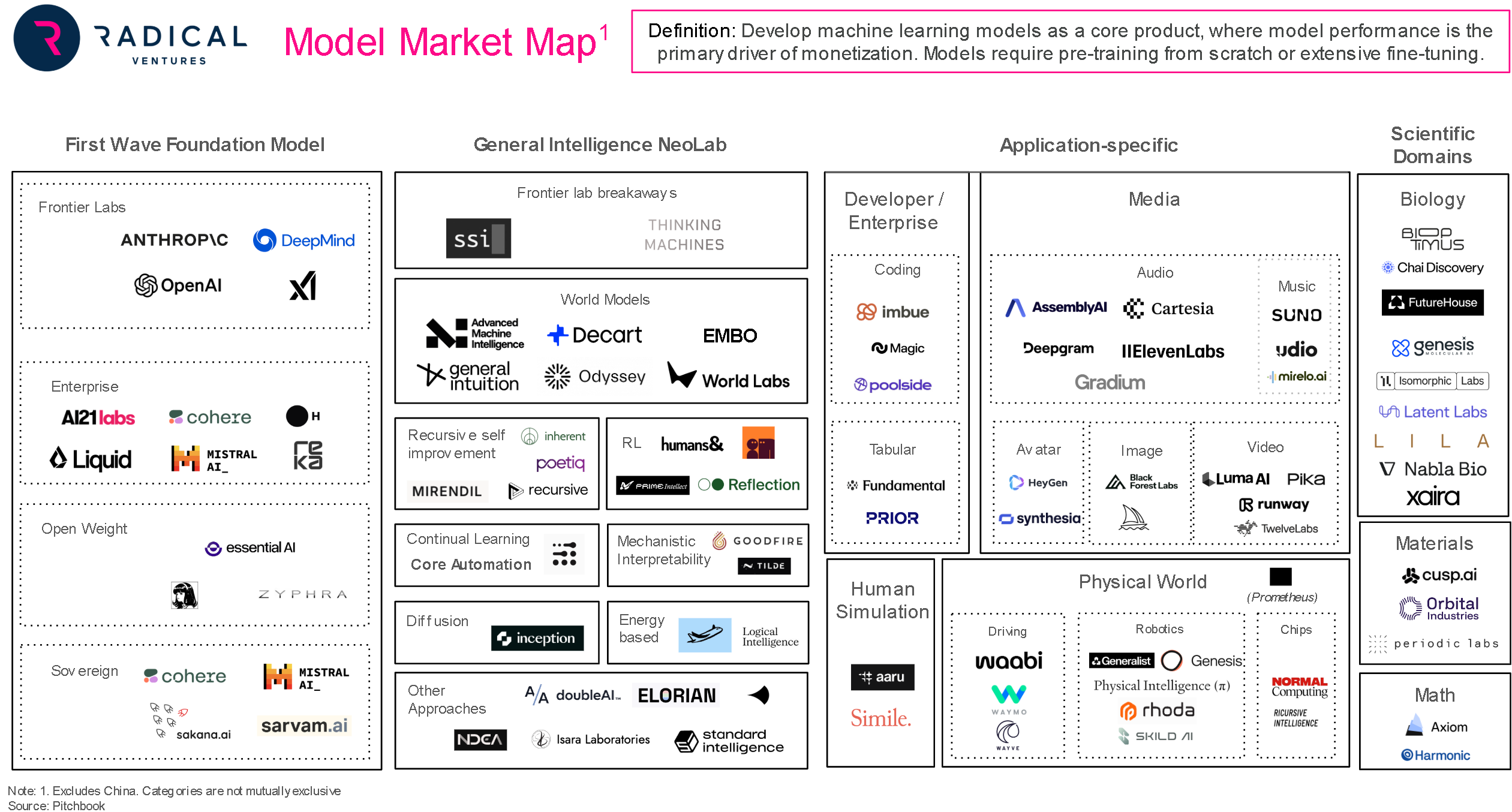
Prime Intellect is building a full stack for agent development, spanning compute access, environments, sandboxes, evaluations, deployment and large-scale reinforcement learning. It functions as a modular platform, allowing teams to select the specific tools or platform elements they need, or they can use the entire stack for easy agents deployment and post-training. Either way, there is no committing to a single closed system, and approach that brings with it business risk.
Customers running Prime Intellect’s stack are training small, specialized models that outperform frontier models on their own workflows. Ramp trained a 35-billion-parameter agent for spreadsheet retrieval that beat a leading frontier model in accuracy while running 27% faster and at a lower cost. A community of more than six thousand teams runs on Prime Intellect, including enterprise customers like Zapier, Character.AI, Arcee, Browserbase, and Flapping Airplanes.
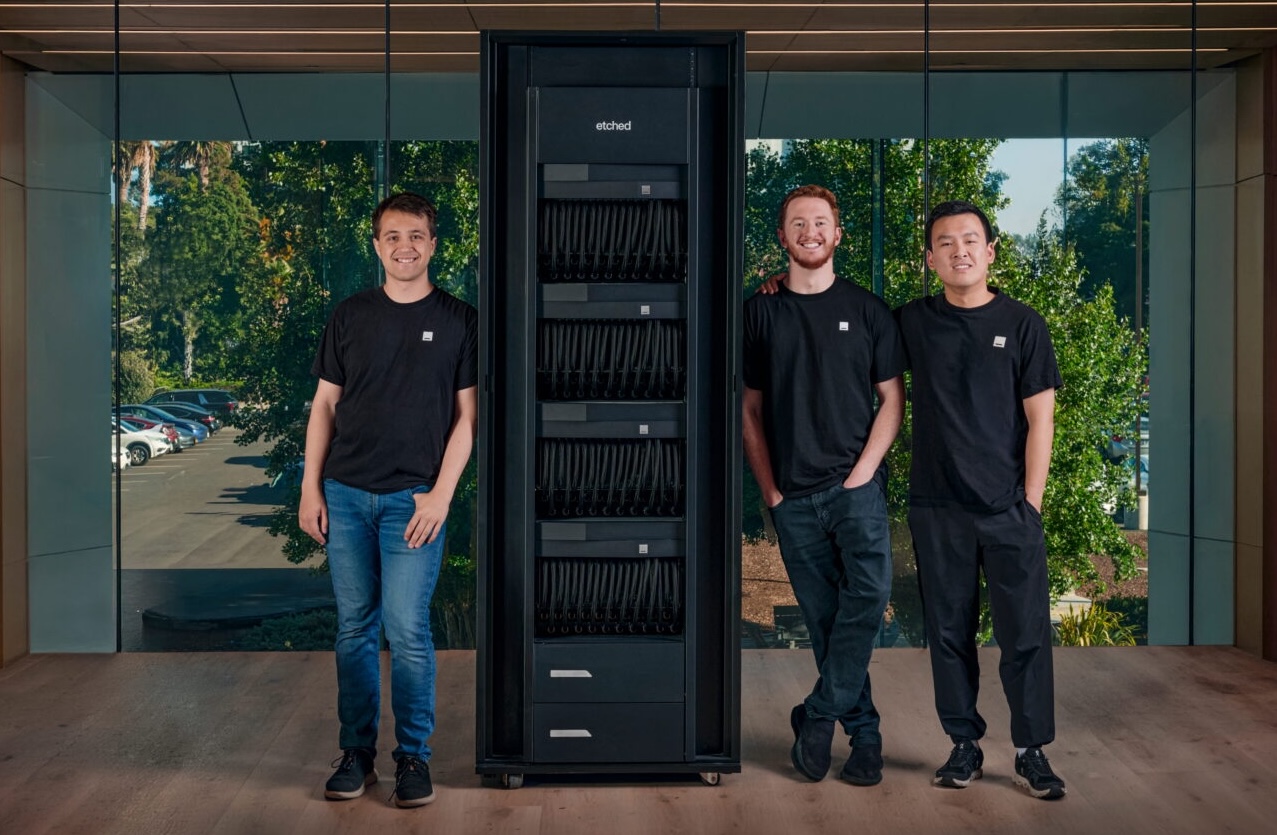
Prime Intellect has pulled together one of the strongest independent research groups in AI. Co-founder and CEO Vincent Weisser came out of the open-science world, where he co-founded VitaDAO to fund research outside traditional institutions. Co-founder and CTO Johannes Hagemann built large-scale LLM training frameworks at Aleph Alpha. Research lead Will Brown, formerly of Morgan Stanley’s machine learning research group, created verifiers, the open-source library that has become a common tool for building RL environments. The team has drawn top researchers to its open mission and has the record to match, shipping a series of open models on its own infrastructure.
We are excited to support Vincent, Johannes, Will and the entire team as they put frontier-scale training within reach of any company ready to compete in the AI era.
For more coverage, read this week’s feature in TechCrunch or Prime Intellect’s blog.
AI News This Week
-
New FireSat Satellites Promise Faster Wildfire Detection over California and Beyond (LA Times)
Radical Ventures portfolio company Muon Space built FireSat, a 50-satellite constellation, with the first three satellites launched from Vandenberg Space Force Base. The network will spot wildfires as small as 16 feet across every 20 minutes globally, a substantial improvement over existing NOAA satellites that detect fires only within a 1,230-foot area. Advanced thermal sensors can distinguish smouldering low-temperature fires from hot, fast-burning ones, a distinction that determines smoke forecasts and evacuation decisions.
-
China Weighs Limits on the AI Models American Companies Love (WSJ)
Chinese models from DeepSeek, Moonshot, and Zhipu have become operational infrastructure within some American companies, prized for good-enough capabilities at a fraction of US frontier costs. Now Beijing is reconsidering that openness, holding early talks with top labs about stricter pre-release review, deferred launches, and restricted foreign access to protect proprietary techniques. With the U.S and China treating frontier models as strategic assets whose availability can shift with policy, the case strengthens for sovereign AI alternatives. Radical Ventures portfolio company Cohere builds enterprise-grade models deployable within a customer’s own borders and data perimeter as sovereign AI, independent of geopolitically driven export restrictions.
-
A $3.2 Trillion Deal-Making Frenzy Is Spurred by the A.I. Economy (NYT)
AI is driving the largest six-month deal-making boom in at least a decade, with $3.2 trillion in global transactions announced through June, a 45 percent jump over the previous year. Forty-four deals topped $10 billion, including NextEra’s $118 billion acquisition of Dominion Energy to supply electricity for AI infrastructure and SpaceX’s $60 billion purchase of code-generation startup Cursor to accelerate its own model development. IPO activity is similarly weighted toward the AI buildout, with Cerebras raising $5.55 billion for its AI chip business and SpaceX pulling in more than $75 billion in the largest IPO ever. SK Hynix followed this week with a $28 billion U.S. listing.
-
Can an AI 'Superforecaster' Beat the Market? (FT)
AI forecasting systems now match financial markets in predicting Fed rate decisions. On aggregate, prediction models from AI startup Mantic aligned with the market during the April 2025 tariff volatility, when odds of summer cuts were briefly mispriced. Mantic makes predictions by analyzing publicly available market data, including Fed communications and prediction market odds from Polymarket. The company has placed fourth in the Metaculus Cup, an international competition where its system outperformed human forecasters.
-
Research: A Significant Increase in Digital Labor Automation (CAIS)
The frontier of AI automation on real freelance work has more than quadrupled in under eight months. The Remote Labor Index tests whether AI agents can complete commissioned projects across 3D and CAD, architecture, design, video, audio, and web development at a quality a paying client would accept, with human judges comparing each deliverable to a professional’s gold-standard work. When the benchmark launched, the top model automated 2.5% of projects; the newest frontier models now reach 15.8%.
Radical Reads is edited by Ebin Tomy (Analyst, Radical Ventures)