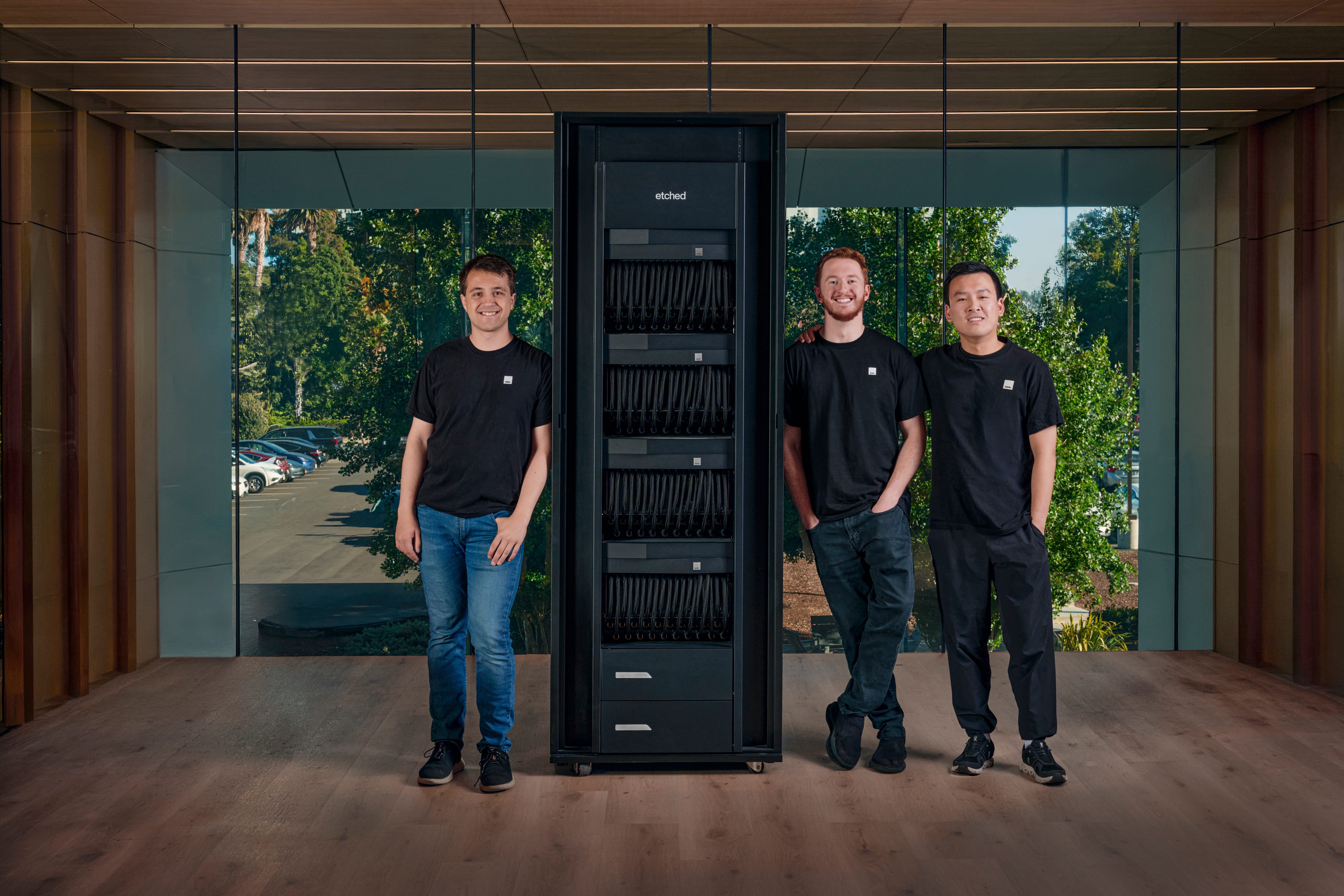
AI inference is rapidly becoming one of the largest computing markets in history, yet only a sliver of the global population has access to the top tier of frontier models. The bottleneck is physical, with power, memory, and wafers constrained while demand sits orders of magnitude higher. This week, Radical Ventures announced our investment in Etched, which is building inference-chip hardware to close this gap.
The Inference Paradigm and the Market Landscape
Gartner predicts that more than 80% of all data center workload accelerators will be dedicated to inference. Current hardware is not optimized for this demand, creating an acute economic bottleneck: critical everyday development applications like Cursor, ChatGPT, and Replit are often forced to run at negative gross margins due to the punishing costs of model inference.
The inference landscape is divided between general-purpose processors built for structural generality and early ASIC players, whose memory architecture increases the total cost of ownership under many common workloads. Within the emerging next-gen startups, MatX and Fractile remain a long way from delivering hardware to the market. Conversely, Etched is now in production moving swiftly to service a massive customer pipeline via their Sohu chip, which delivers unprecedented throughput and latency advantages over the established incumbents.
Cracking the Memory Wall
In generative AI inference workloads, hardware architectures are constantly bottlenecked by the “Memory Wall,” the structural limitation where data transfer speeds cannot keep pace with compute logic processing capacity.
During the iterative decode phase of Large Language Models and the complex execution loops of autonomous AI agents, memory latency and memory bandwidth become the ultimate constraints. To push out the entire curve for throughput and latency, Etched avoids these scaling compromises by co-designing new interconnects, power delivery, packaging, and manufacturing methods around proprietary core technologies, a few of which include:
- Low Voltage Inference (LVI): This architecture enables the highest FLOP density per watt of any processor and delivers world-class throughput on prefill-heavy workloads. It allows Etched to run large models at 80%+ Model Flops Utilization (MFU) while completely avoiding thermal throttling through a novel combination of new math arrays, tiling and scheduling algorithms, power delivery networks, and custom cold plate designs.
- Cluster Scale Memory (CSM): This creates a unified SRAM pool significantly larger than modern GPUs, offering world-class memory bandwidth, interconnect latency, and decode performance. By combining hybrid HBM/SRAM memory subsystems, custom interconnect protocols, and SerDes stacking, Etched builds gigantic, ultra-low-latency scale-up domains. This approach completely avoids the cost, reliability, yield, thermal, and compute tradeoffs plaguing SRAM-only and 3D DRAM architectures.
Our investment in Etched is anchored by immense commercial demand, disruptive economics, and the team’s incredible velocity. Co-founders Gavin Uberti and Robert Wachen have scaled the Etched team from 20 to 400+ engineers in under three years, pulling elite veterans from Nvidia, Google, Broadcom, and SK Hynix. Fueled by this relentless execution, Etched has charted the fastest path to gigawatt-scale production of any AI hardware startup in history. We are proud to partner with Gavin and Rob as they build the next generation of global AI infrastructure.
Learn more about Etched’s latest round from the press release.
AI News This Week
-
Video Search Startup Raises $100 Million From Amazon and VCs (Bloomberg)
Radical Ventures portfolio company Twelve Labs has raised a $100 million Series B co-led by NEA and Naver Ventures, with participation from Radical Ventures, Index Ventures, and Amazon, amongst others. Video accounts for roughly 90% of the world’s data, yet most of it sits unsearchable in archives. Twelve Labs is closing that gap with models like Marengo 3.0 and Pegasus 1.5, which process sound, speech, and motion together to make raw footage queryable at scale. Customers span Hollywood studios, advertisers and sports franchises, with the company now extending its stack to include video agents that can search, explain, and act on footage via text commands.
-
Trump Administration Lifts Restrictions on Anthropic's Fable 5 (Axios)
Government oversight of frontier AI releases is taking shape through direct coordination between labs and regulators. The Trump administration restored public access to Anthropic’s Fable 5 model on Wednesday, 18 days after it was pulled over jailbreak concerns tied to potential cyber and biosecurity misuse. Anthropic worked with the Commerce Department’s Center for AI Standards and Innovation to implement a new safeguard that blocks the vulnerability in roughly 99% of cases. A similar staged release approach was applied to OpenAI’s GPT-5.6. The deadline for standardized federal evaluation benchmarks is set for August.
-
Donald Trump’s Blocking of Anthropic is Capricious and Chaotic (Economist)
When the Trump administration ordered Anthropic to block all foreign nationals from its most capable models, Fable 5 and Mythos 5, it became the first time a government forced a publicly released frontier model offline. Allies who had spent months securing access for their agencies and banks lost it overnight. The episode did not spare Five Eyes partners, and Britain’s AI Security Institute was locked out alongside them, with former British security minister Tom Tugendhat arguing the lesson would push every nation to ask what it needs to achieve sovereignty. Even with access restored on June 30, governments and regulated enterprises are now treating sovereign AI as an operational requirement rather than a preference. Radical Ventures portfolio company Cohere has seen global demand grow dramatically from customers requiring AI and data sovereignty, with enterprise-grade models that run inside a customer’s own geographic and regulatory perimeter.
-
Businesses Face Up to Budget-Busting AI Bills (FT)
The shift from flat-fee to usage-based pricing, combined with the rapid uptake of agentic models that consume far more compute, is driving a surge in AI bills for enterprises. Companies are responding with token caps, model routing tools to use more appropriate and cost-effective models for particular workloads, and open-source alternatives. Goldman Sachs projects a 24-fold increase in global token consumption by 2030, reflecting how central AI has become to how work gets done.
-
Research: Human-like Autonomy Emerges from Self-play and a Pinch of Human Data (NYU/Princeton/Mines Paris/Valeo)
Self-play reinforcement learning can produce driving policies that coordinate with human drivers using only a small anchor of real-world data. Researchers introduce “spiced self-play,” a method that pairs roughly 60 years of simulated driving experience with just 30 minutes to 3 hours of human demonstrations, roughly 2,500 times less data than leading imitation learning approaches use. The resulting policies achieve lower collision rates, less severe impacts when collisions occur, and more human-like behaviour such as maintaining following distances and yielding at intersections.
Radical Reads is edited by Ebin Tomy (Analyst, Radical Ventures)