Bad actors are using AI to attack enterprises and their customers at a scale and sophistication we have never seen. As an AI-focused fund, this comes up in nearly every board meeting and every enterprise conversation we have. It is no longer a tail risk: it’s an existential one.
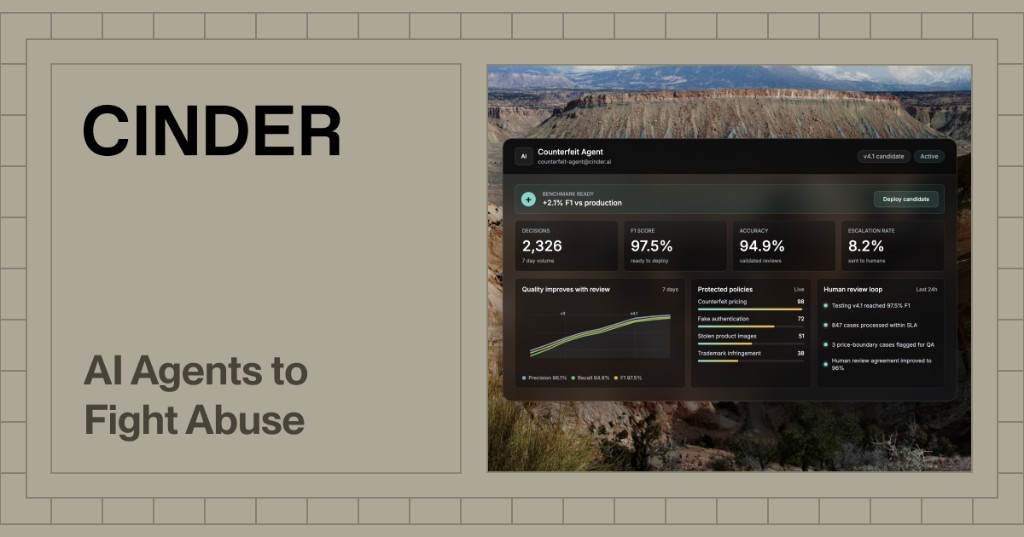
Cinder is an AI-native trust and safety platform that enables enterprises to catch and prevent AI-enabled abuse on their platforms. Cinder’s platform provides i) an end-to-end case management software platform that allows enterprises to moderate, monitor, and escalate violations of their policies; and ii) AI Agents trained to detect violations of policies in real time (without waiting for human moderators), allowing enterprises to prevent threats on their platforms such as abuse, hate speech, sexual violence and non-consensual imagery, fraud, and foreign actor interference.
While legacy tools were designed for a world of human-generated content and predictable threats, Cinder’s platform lets teams turn policy into enforcement in seconds, integrate human and automated decisioning, and adapt to new threat vectors in minutes, not months. Adversaries do not wait for your roadmap, and neither does Cinder.
OpenAI, Spotify, ElevenLabs, Black Forest Labs, Synthesia, and Midjourney all rely on Cinder to protect over three billion users globally from AI-driven abuse. When the most advanced AI companies in the world need to scale safely, Cinder is the infrastructure they choose.
Cinder’s CEO Glen Wise and his team have spent their careers on the front lines of this problem at Meta’s threat intelligence and counterterrorism teams, the CIA, Palantir, and the U.S Department of Defence. They have personally fought nation-state espionage, terrorist coordination, and child exploitation networks. As Glen puts it, Cinder is the bouncer of the internet. There is no team better equipped to build the platform that defends against AI-powered threats.
Radical is the lead investor in Cinder‘s $41M Series B round as the company builds the AI-native trust and safety platform for the enterprise. Cinder is hiring across the board and actively onboarding new customers, from AI-natives to Fortune 500s. If you want to become a customer or join the team, we would love to make the introduction.
Read more in Cinder’s announcement of the round.
AI News This Week
-
Three Things in AI to Watch, According to a Nobel-Winning Economist (MIT Technology Review)
Nobel laureate economist Daron Acemoglu maintains that AI will augment rather than replace most human work, with current data showing that AI is not driving meaningful changes in employment rates or layoffs. He argues that agentic AI is best understood as a tool to enhance specific tasks within a job, since most roles involve fluid orchestration across dozens of distinct activities that benefit from human judgment.
-
Welcome to the Personal Software Revolution (Verge)
The ease of building software with AI coding agents has given rise to “personal software” like to-do lists, trackers, and messaging apps built for individuals’ own use. Apple’s App Store grew 30% in 2025 after nearly a decade of decline, and GitHub saw its fastest growth ever. The shift points to a future where professional developers focus increasingly on infrastructure, while end users tune, extend, and assemble software to fit their exact taste rather than settling for tools designed to be accessible for everyone.
-
Why Brain Implants Are More Than a Sci-Fi Fantasy (Bloomberg)
Brain-computer interfaces (BCIs) are moving from lab experiments to commercial reality. Wireless devices are enabling paralyzed patients to browse the web, play games, and control robotic limbs through thought alone. As Radical Ventures partner Rob Toews wrote in his recent Forbes series on BCIs, this technology is “nearing an inflection point in terms of real-world functionality and adoption.”
-
How AI Could Help Combat Antibiotic Resistance (Wired)
AI could be used to address drug-resistant infections that are projected to cause 40 million deaths by 2050. AI can help prevent unnecessary prescriptions of antibiotics that increase the spread of resistant bacteria, and can help discover new drugs that target these novel threats. With the advent of automated laboratories, generative AI can help run thousands of parallel experiments and screen billions of molecules using deep learning models to design therapeutic compounds.
-
Research: How Fast is Autonomous AI Cyber Capability Advancing? (AISI)
The UK AI Security Institute reports that the length of cyber tasks frontier models can complete autonomously is doubling every 4.7 months, down from an estimate of 8-months just last November. Claude Mythos Preview and GPT-5.5 exceeded even this accelerated trend, with Mythos Preview becoming the first model to complete AISI’s “Cooling Tower” cyber range, a simulated enterprise network attack. The same capabilities are strengthening cyber defenders, with AISI noting significant recent gains in AI-assisted vulnerability discovery.
Radical Reads is edited by Ebin Tomy (Analyst, Radical Ventures)