This week, Radical Ventures announced our Seed investment in Inherent, a new AI lab whose mission is to build AI that recursively self-improves to discover new knowledge.
AI leaders increasingly believe that recursive self-improvement, by which AI systems directly design and build better AI systems, will be the most important mechanism for progressing from current AI capabilities to superintelligence. All the major labs are implementing versions of this internally and have published initial proofs of concept (e.g., Sakana’s AI researcher, DeepMind’s Co-Scientist, Andrej Karpathy’s Autoresearch), yet these efforts merely layer AI into workflows built for an earlier paradigm of human-led research, such as software engineers adopting coding models. Inspired by historical transitions such as the adoption of steam power and electrification, Inherent believes that realizing the full potential of recursion requires entirely reinventing the research lab, much as the electrical generator only delivered on its promise once factories were wholly redesigned, ultimately yielding the innovation of the assembly line.
Inherent is embracing this challenge and pioneering the transformation. Their AI scientist system, Faraday, exists as a first-class citizen, equivalent to other (human) employees, with the capability to source relevant research papers, attend team meetings, autonomously carry out experiments, manage compute infrastructure, help with recruitment, and more. As Faraday improves, the company will accelerate not only technically but also operationally. Such a virtuous cycle has the power to enable Inherent to surpass even the best-resourced labs of today.
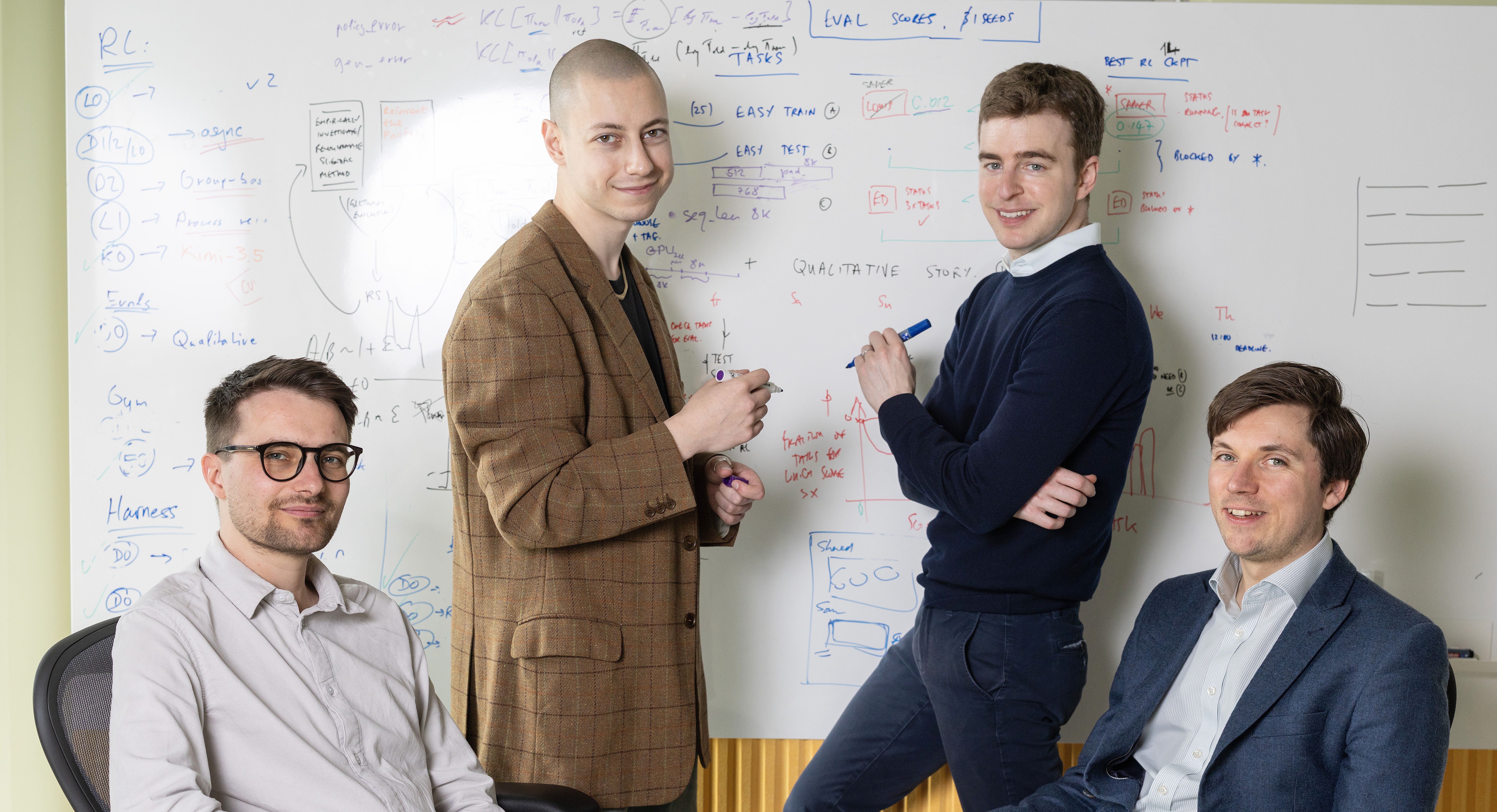
What excites us most is the founding team which has been at the vanguard of recursion for a decade. Before serving in the White House, Tantum (Teddy) Collins led initial efforts in this vein at DeepMind and productized components that were put into operation internally. Ed Hughes has been pushing the frontier of “open-endedness” (open-ended knowledge discovery) and most recently co-led the AI Scientist team at DeepMind. His co-lead was Louis Kirsch, who previously did his PhD with Jürgen Schmidhuber, one of the earliest and most prominent proponents of this direction. Kaloyan (“Kally”) Aleksiev was one of the first engineers at Reka (another Radical portfolio company) and built the company’s inference infrastructure, critical to conducting recursion. One would be hard-pressed to find another team with as much hands-on research and engineering experience in this domain as this one.
We are thrilled to partner with Teddy, Ed, Louis, and Kally as they embark on this journey.
To learn more about Inherent’s vision in the founders’ own words, read their manifesto here.
AI News This Week
-
Orbital Industries, Startup Using AI to Discover Exotic New Materials, Raises $50 million Series B Funding Round (Fortune)
Radical Ventures portfolio company Orbital Industries has raised a $50 million Series B led by Plural, with participation from Nvidia’s Nventures and existing investors, including Radical. The company’s core model, Orb, simulates the quantum mechanical behaviour of up to 100,000 atoms on a single GPU, running roughly 10x faster than competing models from Meta and Microsoft. Orbital’s first commercial product is a family of liquid coolants designed to manage the extreme heat of GPU server racks, developed in months rather than the decade such work typically requires.
-
Why Trump’s AI Executive Order was Pulled (Axios)
The Trump administration shelved a planned AI and cybersecurity executive order hours before it was scheduled to be signed, after pushback from AI adviser David Sacks and tech CEOs. The order would have established voluntary model testing and security-vulnerability protocols, but internal critics dismissed it as driven by “doomers,” and questions surfaced about why the Treasury Department would lead vulnerability reviews rather than CISA or NIST.
-
AI Just Solved an 80-year-old ‘Erdős Problem,’ and Mathematicians are Amazed (Scientific American)
A language model has disproved a well-known geometry conjecture posed by Paul Erdős in 1946, marking what experts called the first AI-generated proof worthy of publication in a top math journal. The model solved the “unit distance” problem by constructing a higher-dimensional lattice and projecting it onto two dimensions, an approach no human had attempted despite the tools already existing. Mathematicians who verified the result noted that AI’s edge was its patience to pursue tedious paths that human researchers, biased toward proving Erdős right, had consistently overlooked.
-
A Reality Check on the AI Jobs Hysteria (MIT Technology Review)
Despite predictions that AI is about to gut white-collar work, US labour data shows no broad disruption, and unemployment is actually lower in AI-exposed occupations than in less-exposed ones. Economic data show a 16% drop in headcount among 22- to 25-year-olds in highly automatable fields like software development since 2024, even as employment for older workers has grown. Researchers attribute the split to AI’s ability to replicate the codified knowledge young graduates bring while leaving tacit, experience-based work intact, a dynamic that may impact the traditional earn-while-you-learn career model.
-
Research: Code as Agent Harness (UIUC/Meta/Stanford)
A 100-page survey from UIUC, Meta, and Stanford argues that the next frontier in agentic AI will be defined by harness engineering rather than new base models. The authors frame code as the operational substrate connecting reasoning, action, memory, and verification, and propose that production agents must be executable, inspectable, stateful, and governed. They trace how production harnesses like Claude Code, Codex, and Cursor’s Composer are becoming the training data for the next generation of models, blurring the boundary between agent and infrastructure.
Radical Reads is edited by Ebin Tomy (Analyst, Radical Ventures)