In June 2024, Ilya Sutskever announced the creation of a new lab with “one goal and one product: a safe superintelligence.” Within four months, Safe Superintelligence (SSI) had raised $1 billion, and less than a year later it was valued at $32 billion, still without a public roadmap. The point was not what SSI had demonstrated but rather whom they had assembled, what they were pursuing, and how much capital was willing to follow.
SSI did not appear in isolation. A cohort of researcher-led labs was coming into existence: Thinking Machines, World Labs, Reflection, and others, built from teams leaving OpenAI, Google DeepMind, Meta, and pedigreed professorships. Together, they marked the arrival of a new shape of company: the NeoLab, a startup focused on long-term technical breakthroughs, typically founded by research scientists and engineers from leading AI industrial or academic organizations.
Up until then, the post-ChatGPT frontier had looked largely settled; capital requirements seemed too large for startups to match, leading talent had concentrated inside a handful of players, and the hyperscalers had paired off with their chosen labs (Microsoft with OpenAI, Amazon with Anthropic, and so on).
Then, the floodgates opened.
Over the next three years, 40+ NeoLabs raised $40B, frequently with billion-dollar first rounds, proving that frontier-scale ambition was no longer the prerogative of incumbents.
OpenAI and Anthropic are the existence proofs
This wave of NeoLabs builds on precedent, prior examples of teams that reached the frontier from a standing start, each with a distinctive thesis.
OpenAI was the original. Founded in 2015 by Sam Altman, Greg Brockman, Ilya Sutskever, Elon Musk, and a small group of researchers, the company, after a few years of broader exploration, went all-in on an approach that was, at the time, unproven: scaling the transformer architecture. Sutskever’s intuition, formed through his earlier work on AlexNet and Seq2Seq, was that sufficiently large neural networks trained on enough data would produce capabilities that smaller, more carefully designed systems could not. Intelligence, per this view, would emerge from scale rather than from clever architecture. GPT-1, GPT-2, and GPT-3 vindicated the bet, and with the launch of ChatGPT, the view became consensus.
Cohere, founded in 2019 by Aidan Gomez (co-author of the original transformer paper at Google Brain), Ivan Zhang, and Nick Frosst, followed an orthogonal path. While OpenAI pursued the consumer frontier, Cohere bet that the same underlying technology could be turned into an enterprise-grade platform and built one of the first credible alternatives to the incumbent labs for businesses deploying LLMs in production.
Anthropic followed in 2021, when siblings Dario and Daniela Amodei and five others researchers left OpenAI to found the company. With their own conviction in scaling, along with an outspoken stance on safety, they increasingly focused on achieving SOTA performance in AI’s most commercially important domain: coding.
Companies such as these established the breakaway pattern that later NeoLabs would follow: a research team splitting from a frontier incumbent to advance a specific thesis with the aim of reaching the frontier themselves.
For several years, these bets remained contested; now, in 2026, the trajectories are no longer in serious dispute. Generating tens of billions of dollars in annualized revenue and earning valuations in the hundreds of billions, these companies answer the question every aspiring NeoLab founder is asked (“Can a new team actually reach the frontier?”) and serve as the existence proofs that VCs cite when underwriting investments.
Model providers have proliferated
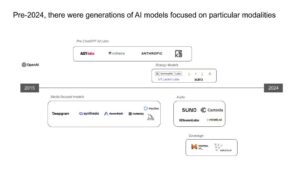
Before 2024, foundation model providers often arrived in bunches, generally tied to a specific modality or strategy: LLMs, biology, media, audio, sovereignty.
Since then, the foundation model landscape has expanded dramatically and today comprises roughly a dozen distinct categories, each with a sizable capital pool and talent base.
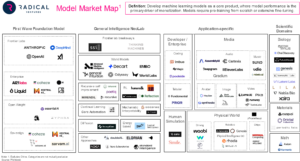
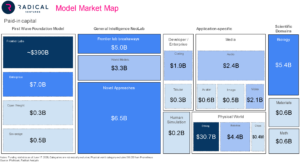
The frontier labs alone sit on nearly $400B in cumulative funding. That is the gravitational center of the market and the reason many believed the space to be saturated. Around that focal point, the rest of the first wave is relatively small: enterprise-dedicated players sit at $7B and open-weight and sovereignty-oriented entities at under $1B.
The NeoLabs pursuing general intelligence constitute their own block: $15B across frontier-lab breakaways, world model developers, and a basket of other novel approaches.
NeoLabs are pursuing particular paradigms
NeoLabs are usually dedicated to specific techniques or approaches that they believe will unlock capabilities on the road to general intelligence. A range of directions is emerging (in no particular order):
- World models. These companies assert that LLMs trained on text will hit a ceiling, which multimodal and/or real-world data (e.g., video, sensor, embodied interaction) will transcend. If their view is right, the next foundation model is a predictor not of the next token of a given language but rather the next state of a given environment. Examples include World Labs, AMI, and Decart.
- Recursive self-improvement. Here we have companies closing the loop such that models propose and incorporate improvements to their own neural network or system architecture (or even the larger organization building the model). Each generation builds on the last in an iterative fashion, exploring the broader combinatorial space and hill-climbing to the global maximum. Examples include Recursive and Inherent.
- Reinforcement learning. Per this perspective, LLMs merely compress and recombine existing human knowledge; they cannot discover or innovate. Agents learning from grounded feedback in high-fidelity simulators — a player winning at Go, an equation being solved, a molecule binding — push past human priors into genuinely novel insight. Examples include Ineffable Intelligence and Reflection.
- Continual learning. Today’s frontier models are frozen following training. This view bets that intelligence requires lifelong adaptation: models that update weights from streaming experience, while preserving critical learnings from the past. The next foundation model is not a snapshot but an evolving system that compounds over its operational life. Examples include Core Automation and Adaption Labs.
- Diffusion. Nearly every frontier model today generates text autoregressively (one token at a time, each conditioned on all prior tokens). This is inherently sequential, creating a bottleneck due to limited memory bandwidth and communication overhead. Proponents of this paradigm argue that diffusion-based techniques supersede autoregressive approaches by parallelizing large-scale inference. Models generate full blocks of output, which they refine through iterative denoising, promising orders-of-magnitude lower latency. Examples include Inception Labs.
- Energy-based models. A central claim here is that probabilistic, autoregressive generation is structurally unsuited to problems that demand verifiability. Energy-based models instead score candidates against a set of constraints and treat inference as a search for the configuration that scores best. If this view is right, the next foundation model deliberates over whole solutions rather than generating tokens sequentially, thereby unifying perception, planning, and reasoning under one objective. Examples include Logical Intelligence and Flapping Airplanes.
Funding has become a frenzy
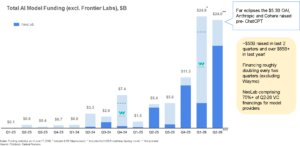
Quarterly venture funding for model providers (excluding frontier labs) sat below $1B through early 2024. The curve inflected at SSI and has only accelerated over the last 3 quarters.
For comparison, OpenAI and Anthropic together raised $5.3B total over the seven years between OpenAI’s founding and ChatGPT. The NeoLab wave has raised roughly 7x that in just the last year, and nearly 5x in the last two quarters alone.
North America + Europe – $1B+ AI Model Funding Rounds
Excluding frontier labs and as of 2025
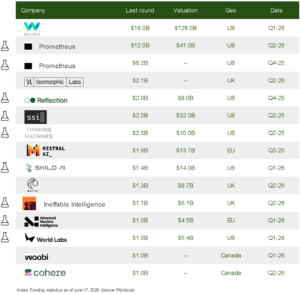
Billion-dollar rounds are rare in venture, rarer still pre-PMF. Yet since the start of 2025, 13 model providers in North America and Europe have raised at that scale, 8 of them NeoLabs. The US accounts for the majority, but Canada, the UK, and continental Europe make up nearly half, with Isomorphic Labs, Mistral, Ineffable Intelligence, Advanced Machine Intelligence, Wayve, Cohere and Waabi all clearing the threshold. The billion-dollar NeoLab round is now a recurring phenomenon on both sides of the Atlantic.
Talent is flowing out of the incumbents
NeoLab founders overwhelmingly come from frontier labs and leading academic groups, and the distribution is notably lopsided. DeepMind stands out as the dominant source by a wide margin, accounting for more than 40 founders – more than the other three frontier labs combined. Over the past decade, breakthroughs like AlphaGo, AlphaStar, and AlphaFold made DeepMind the premier destination for frontier AI talent, and many of the researchers behind those efforts have now gone on to start their own entrepreneurial endeavors.
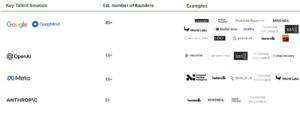
PhD programs are also now direct sources of founder talent, not just an upstream pipeline. Stanford, Berkeley, MIT, Oxford, Harvard, Cambridge, and CMU are producing founding teams that come together in academia and raise without ever having worked in industry.
The cap table is concentrated
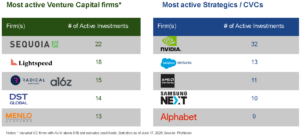
Generalist multi-stage firms are among the most active investors across the model provider landscape, with Sequoia and Lightspeed ranking near the top. Radical Ventures stands out as one of the few AI-native firms operating at a comparable level of activity amidst the foregoing names and other generalist funds like a16z.
Among strategic investors, NVIDIA is the most active, more so even than any institutional VC. That a chipmaker sits at the top of the table is not accidental; compute for training and inference typically accounts for well over half of a NeoLab’s spend, and VC financing alone is rarely sufficient to support frontier-scale compute needs. As a result, strategic compute partnerships — hyperscaler commitments, NVIDIA allocation agreements, and neocloud financing structures — have become standard features of foundation model companies’ cap tables. In fact, the real constraint is no longer capital but rather access to guaranteed, multi-year compute capacity. Labs that can secure this vital resource have the potential to outpace even more well-funded competitors that cannot.
NeoLabs draw bulls & bears
What investors are chasing is the ultimate power law: most NeoLabs will not reach the frontier, but the one that does may justify the entire portfolio.
Bull: join the frontier. Follow the Anthropic playbook: split off from an incumbent, raise tens of billions of dollars, and build an enduring research and product flywheel. This requires a differentiated research bet, a commercial wedge that compounds, and uninterrupted access to capital and compute. Such a path is increasingly fraught as more competitors come into existence and their need for compute and talent grows.
Base: strategic acquihire or vertical exit. In this scenario, a lab’s talent and IP get absorbed by a hyperscaler, frontier lab, or a large enterprise software player. Outcomes span clean strategic acquisitions to complex reverse-acquihires which may exclude or limit capital flowing to the investors. The caution here is that the universe of natural acquirers is limited and shrinking as most hyperscalers have already paired off, and regulatory scrutiny of acquihire structures is increasing.
Bear: wind-down / fire sale / zombie. Here, confidence and capital run out before a team can create a sustainable business. Talent leaves for incumbents offering 10x compensation, companies have too much altitude to seek a soft landing, and IP gets stranded.
Key risks underlie NeoLab investments
- Distillation / open-weights: Capabilities commoditize faster than teams can build a commercial moat.
- Capital intensity: Teams are unable to fund the next compute cycle through dilution-tolerable rounds.
- Moving target: Frontier labs leapfrog (e.g., Magic/Poolside vs. Codex/Claude Code).
- Shallow buyer pool: Many natural homes already have taken reservations, so to speak.
- Commercial chasm: Revenue scales but not enough to justify sky-high entry valuations.
The first wave was about pushing scaling laws to the limit. Along the way, leading luminaries have asserted that alternative paradigms will yield faster or more sustainable progress. The jury is still out; such is science at the frontier.
With $40B+ fueling 40+ independent labs and financing doubling every two quarters, competition is intensifying and compute and talent are increasingly binding constraints. The NeoLab era has begun.
Are you a NeoLab founder looking to advance the frontier? If so, please reach out to rich@radical.vc and aaronr@radical.vc. We would love to speak with you!
Radical Ventures is proud to partner with leading foundation model providers including Cohere, Decart, Generalist, Genesis Molecular AI, Inherent, Latent Labs, Nabla Bio, Orbital Industries, Periodic Labs, Prime Intellect, Reka, Ricursive Intelligence, Twelve Labs, Waabi, and World Labs.
Radical Reads is edited by Ebin Tomy (Analyst, Radical Ventures)